Showing posts with label drought. Show all posts

Sunday, November 9, 2014

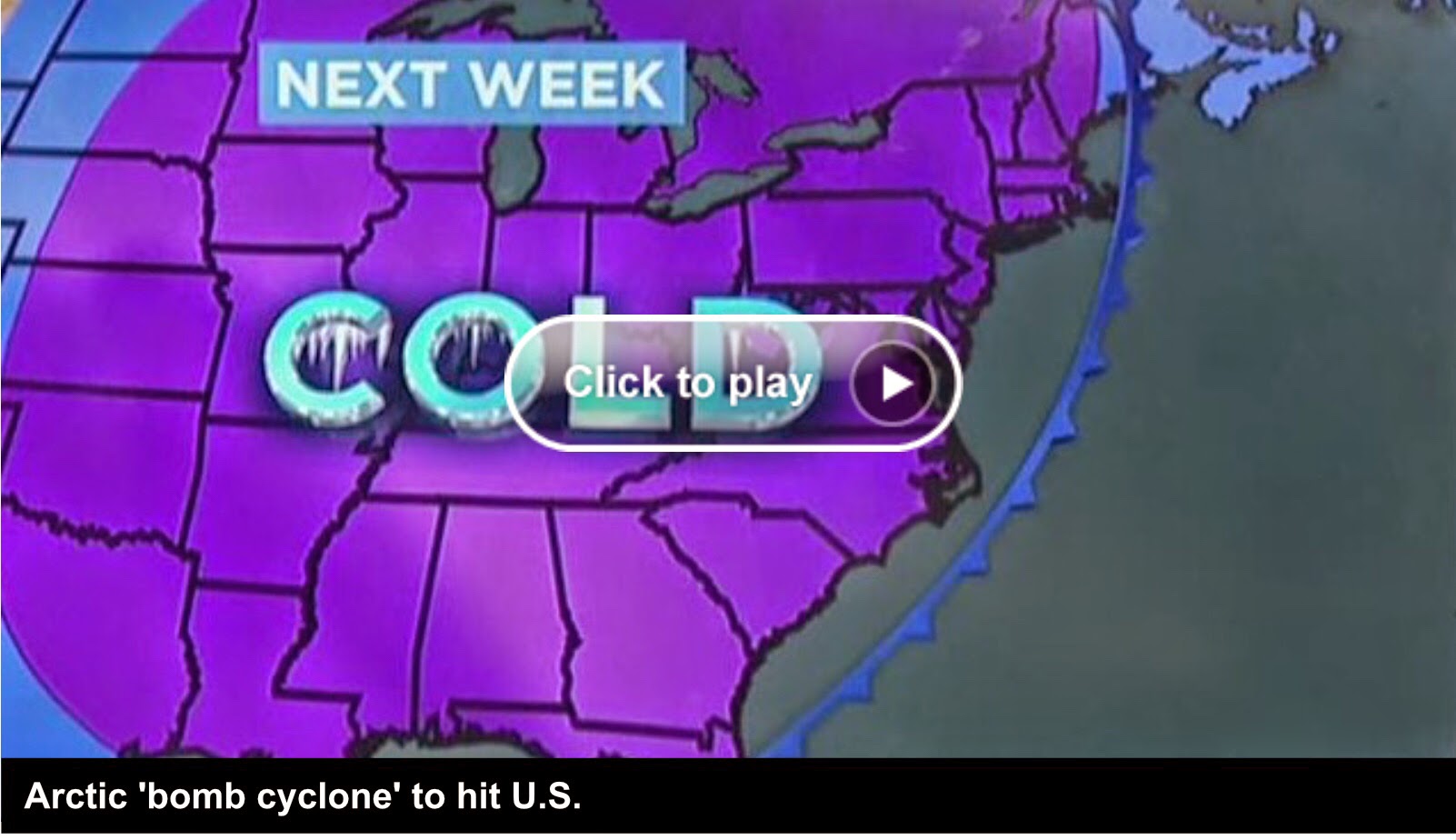
Arctic snap will ice Northern states, whipped down by 'bomb cyclone'

(CNN)The ice man cometh. And does so early this year, after a former Pacific typhoon flew up toward the Arctic and rammed the jet stream.

The stream has whipped south, dragging down frigid air from Canada over the northern Plains and Mountain States and the Upper Midwest, according to the National Weather Service.

It is already plunging temperatures below freezing there and will hammer them into the teens and single digits in many places by midweek, even lower in others.

Great Falls, Montana, will shiver at 9 below zero on Tuesday night.

It’s the coldest weather of the season, the weather service said.

Minneapolis could soon get a foot of snow, the service said, with the Minnesota city experiencing below-freezing temperatures that could last for eight days.

Let it snow

The snap is forecast to lay down the first broad layer of wintry snow, flurries, sleet or ice — long before winter starts — from Montana down to Nebraska and over to Wisconsin.

It will accumulate in inches in the northern Rockies, northern Plains and Great Lakes.

People farther south will also shiver. "Much of the nation east of the Rockies is expected to see a major pattern change by the beginning of the work week," the weather service said.

The western Dakotas are also forecast to get significant snow.

Lows will drop to freezing in Kansas City late Monday, then into the 20s a night later. The snap will stop short, leaving much of the Deep South and Southwest in a fall-like warm zone.

Rain is expected to hit Chicago and Milwaukee on Monday and Tuesday, with a few snowflakes mixed in, according to the service on Sunday afternoon.

Courtesy of Nuri

Residents in the northern United States can thank a whopping tropical cyclone in the Pacific Ocean for the wintry blast.

The remnants of super Typhoon Nuri rolled up north over Alaska’s Aleutian Islands on Friday, kicking off the ripple of Arctic air in the other direction.

Nuri is now the strongest known Northern Pacific cyclone on record, according to the National Weather Service Ocean Prediction Center.

Its remnants plowed into cold air adding violent energy as it went north, similar to what Superstorm Sandy did in the Atlantic two years ago. That earned it the weather moniker "bomb cyclone. More


Wednesday, March 19, 2014

Drought causes extreme emergency in Haiti

A state of emergency has been declared across northeastern Haiti. This is a country where 78 per cent of the population lives below the poverty level. A severe drought is wiping out sorely needed crops and livestock.

The dry season is due to last at least another month. Even then it will take the area at least another six months to recover when the rains do finally come.

The eight month long drought has caused the loss of two harvest seasons. The hardship is evident in some schools where there is food for students but no water to cook with.

There has been some rain in the area recently but not enough to replenish crops. Indeed the second rainy season began later than usual last year.

Until last November, rainfall had been evenly spread across the crop-producing areas, but that second rain season which usually comes in August, was almost three weeks late. To make matters worse, northeastern Haiti received very little of that rainfall.

Nearby, Jamaica has also been in a state of drought. The government has recently had to dispatch water trucks to the drought-parched west of the island.

The Ministry of Water, Land, Environment and Climate Change says that at least six parishes have been affected, including the one that holds the popular tourist spot of Montego Bay.

There is the possibility of some thundery showers around the northern Caribbean this week, but many places will not see any wet weather. The dry season across the Greater Antilles runs until the end of March. More


Friday, March 14, 2014

Pakistan’s Impending Famine

Thar, Sindh, Pakistan

It’s hard to catch a break in Pakistan.

Extremist violence is widespread, earthquakes and flooding are routine, and polio remains endemic. No nation has a higher infant mortality rate, and only a few have more cases of tuberculosis. Nearly half the country’s 180 million people lack access to safe water, and many Pakistanis have experienced power outages of up to 20 hours per day. Given such stresses, it’s not surprising that up to 16 percent of the country suffers from mental illness.

And now comes the latest scourge: Famine.

In recent days, media reports have revealed that dozens of people—many of them children—have died from malnutrition over the last three months in the bone-dry desert region of Thar, in the southern province of Sindh. And yet things could soon get much worse. A recent UNICEF report, noting that drought has “devastated” crops and livestock and that “hundreds of thousands” of people have fled, warns of a possible “massive humanitarian crisis” in Thar. Ominously, almost 3 million people “risk starvation” across Pakistan.

Many Pakistani press accounts—and numerous Pakistani politicians—depict the Thar tragedy as a catastrophic case of negligence by Sindh’s provincial government. They fault local officials for taking too long to get food assistance to those in need late last year when drought conditions first began to set in. And they single out authorities for failing to transfer sick children in remote areas to better hospitals.

Yet the Thar famine also reflects another type of failure: that of democracy.

In recent years, Pakistan—a country ruled by the military for about half its existence— has made remarkable democratic progress. With successive free elections, civilian rule is firmly in place. Pakistan’s mighty military has mellowed. Constitutional amendments have decentralized power. The Supreme Court is increasingly targeting powerful people and institutions. And private media outlets have rapidly proliferated.

However, there are limits to this progress.

The most commonly cited obstacles to deeper democratization are the military, which continues to exert heavy influence over politics; a lack of pluralism and tolerance, which contributes to the deplorable plight of religious minorities; and the country’s abysmal law enforcement, which enables militants to operate with impunity.

Yet the tragedy in Thar underscores a more insidious and underreported threat to democracy: Astounding manifestations of land inequality.

In Sindh, a paltry 0.05 percent of households hold more than five acres of land (the figure is similar in Punjab, Pakistan’s most populous province). In the nation as a whole, 2 percent of households own nearly 50 percent of land, while 5 percent of agricultural households own nearly two thirds of Pakistan’s farmland.

This means that the majority of the population holds little to no land. Without land, it’s difficult to access food and water (and it’s also difficult to earn a livelihood; landless Pakistanis make up 70 percent of the country’s rural poor). Most Pakistanis must depend on a tiny, wealthy landowning minority for access to these natural resources.

These resources, and the land that holds them, are becoming increasingly precious. According to one alarming estimate, Pakistan loses three acres of good agricultural land every 20 minutes. In Thar, land and natural resources are further imperiled by Islamabad’s plan to tap into the region’s vast coalfields to ease the country’s severe energy crisis. Officials insist there will be no deleterious impacts on local communities, but there’s good reason to fear that such exploitation could cause environmental distress and displacement, and deprive an impoverished region of a critical natural resource. These are very real problems in equally dry and poor Baluchistan, a province long subjected to intensive natural resource extractions by Islamabad and large corporations. Such conditions have helped fuel a long-running separatist insurgency.

In effect, millions of Pakistanis have neither the land to grow food nor the money to buy it. And yet little is done to help them. Landed rural elites—the essence of vested interests in Pakistan—seemingly spend more time blocking critical agricultural reforms (including those that would increase the tax base) than addressing the plight of the landless. They have also been accused of siphoning off irrigation water flows from poor farmers, and of diverting floodwaters away from their crops and into more vulnerable communities. What’s particularly troubling about all this is that these wealthy landowners are often politically connected, or politicians themselves (Sindh’s landed rural elite is a strong base of support for the Pakistan People’s Party, or PPP, which runs the Sindh government).

Consider the strikingly blasé reactions of local officials to current conditions in Thar. Apparently unmoved by (or oblivious to) UNICEF’s warnings of a massive crisis, PPP leaders have described events of recent days as “normal” and “nothing new.” Sindh’s advocate general, speaking Monday at a hearing convened by Pakistan’s Supreme Court, expressed regret, but also appeared to lay the blame on parents for not taking their kids to the hospital.

Perhaps most egregious of all, after federal officials toured affected areas this week, Sindh’s government hosted a lavish buffet lunch featuring fried fish and biryani —“an act of such monumental stupidity and insensitivity,” according to one Pakistani editorial, “that it beggars belief.”

Call this heartlessness, or call it apathy. Many Pakistanis call it feudalism—the embodiment of a system in which imperious landed elites lord over their hapless subjects. One thing you can’t call it, however, is democracy. Yes, it’s an imperfect institution—but surely it doesn’t sanction such vast disparities in land ownership, or the type of leadership that seems unmoved by the humanitarian crises spawned by those disparities.

The takeaway here is that in Thar, people are dying because of deeply entrenched inequalities that make them profoundly food insecure and hyper-vulnerable to calamities—like drought and disease—that more fortunate people elsewhere can withstand and survive.

Ultimately, the dead and dying of Thar—just like slaughtered Shia Muslims, the military’s large political footprint, and state sponsorship of militancy—underscore the fact that despite considerable achievements in recent years, democracy in Pakistan remains a work in progress.

Michael Kugelman is the senior program associate for South Asia at the Woodrow Wilson International Center for Scholars in Washington, DC. He can be reached at michael.kugelman[@]wilsoncenter.org or on Twitter @michaelkugelman.


California Exceptional Drought Worsens

I keep hearing from some people how the storms at the end of February and the start of March had to have helped the California drought.

That all the rain that fell in the lowlands and snow in the Sierra had to have had an impact. Right after the storms in my , I was already pointing out that this was not the case. One set of storms does not end a three-year drought. In that post I stated, "The drought in California did not just develop this year, or in the last 12 months, but over the last three years. It is unrealistic to think one series of storms is going to have a huge impact on the long-term drought..."

Now, two weeks later, here is more evidence that the short period of rain and mountain snow had little impact.

Below is a comparison of the Drought Monitor maps for California from Feb. 18 (before the storms) and the one released today.

Over this span of time the area coverage of D4 drought conditions (exceptional) has actually increased substantially from 14.62 percent to 22.37 percent of the area, covering the rich farming area of the Central Coast to the San Joaquin Valley. The D3-4 area (extreme drought) did come down a little from 68.30 to 65.89, mostly in southwestern California.

I have already shown that many reservoirs in central and northern California are still at near-record low levels. The graph below shows the daily Sierra snowpack this year, compared to the previous two years and to normal.

With no substantial rain and snow expected for at least another week, and a round of near-record temperatures likely in the Central Valley and southwestern California coming for this weekend, all of these stats are not going to get any better. In fact, there is a good chance of below- to well below-normal precipitation over the next couple of weeks.


Wednesday, March 5, 2014

Extreme weather is 'silver lining' for climate action: Christiana Figueres

Devastating extreme weather including recent flooding in England, Australia's hottest year on record and the US being hit by a polar vortex have a "silver lining" of boosting climate change to the highest level of politics and reminding politicians that climate change is not a partisan issue, according to the UN's climate chief. Christiana Figueres said that it was amoral for people to look at climate change from a politically partisan perspective, because of its impact on future generations.

The "very strange" weather experienced across the world over the last two years was a sign "we are [already] experiencing climate change," the executive secretary of the UN climate secretariat told the Guardian.

The flooding of thousands of homes in England because of the wettest winter on record has brought climate change to the forefront of political debate in the UK. The pprime minister, David Cameron, when challenged by Labour leader, Ed Miliband, on his views on man-made climate change and having climate change sceptics in his cabinet, said last week: "I believe man-made climate change is one of the most serious threats that this country and this world faces."

Climate change was barely mentioned at all in the 2012 US election battle until superstorm Sandy struck New York, prompting the city's then mayor, Michael Bloomberg, to endorse Barack Obama's candidacy because he would "lead on climate change."

Figueres said: "There's no doubt that these events, that I call experiential evidence of climate change, does raise the issue to the highest political levels. It's unfortunate that we have to have these weather events, but there is a silver lining if you wish, that they remind us is solving climate change, addressing climate change in a timely way, is not a partisan issue."

She added: "We are reminded that climate change events are for everyone, they're affecting everyone, they have much, much longer effects than a political cycle. Frankly, they're intergenerational, so morally we cannot afford to look at climate change from a partisan perspective."

Figueres said that examples of recent extreme weather around the world were a sign climate change was here now. "If you take them individually you can say maybe it's a fluke. The problem is it's not a fluke and you can't take them individually. What it's doing is giving us a pattern of abnormality that's becoming the norm. These very strange extreme weather events are going to continue in their frequency and their severity … It's not that climate change is going to be here in the future, we are experiencing climate change."

Figueres was speaking in London before meeting businesses including Unilever, Lafarge and Royal Dutch Shell to urge them to put pressure on governments to take action on climate change, ahead of renewed international negotiations in Bonn next week to flesh out details of a draft climate treaty to be laid out in Lima this year and agreed in Paris at the end of 2015.

"2014 is a crucial year because of the timing of next year, [in 2015] there will be very little time work on the actual agreement. We have to frontload the work," she said.

Peru's foreign minister told the Guardian in January that the Lima meeting in December must produce a first draft of a deal to cut carbon emissions, which will be the first of its kind after efforts to get legally binding agreement for cuts from most of the world's countries failed at a blockbuster meeting in Copenhagen in 2009.

Asked if a bad deal was better than no deal next year, she said: "Paris has to reach a meaningful agreement because, frankly, we are running out of time."

But she dismissed parallels with the run-up to the Copenhagen summit, saying the frequency of extreme weather events, lower renewable energy costs and progress on climate legislation at a national level meant it was different this time round.

"I hope that we don't need too many more Sandys or Haiyans or fires in Australia or floods in the UK to wake us up. My sense is there is already much momentum.We have 66 governments that have climate legislation, we have a total of 500 laws around the world on climate, whereas before Copenhagen we only had 47."

But the grouping of the world's 47 "least developed" countries said this week that they would want far more money to adapt their economies to climate change than the $100bn a year that been so far proposed by rich countries.

"We will want more than the $100bn to agree to a new Paris protocol," said Quamrul Choudhury, a lead negotiator for the group which includes many African and Asian countries. "On top of that we will want a legal mechanism to compensate for 'loss and damage' [compensation for extreme climate change events]. There should definitely be some space in the [final] treaty for that," he said in London.

He called on rich countries to compromise. "The battle lines are drawn. Everyone wants to defend their country and nobody will give an inch, but everyone has to make some sacrifice or we won't have a deal. We need high-level political commitment to raise ambition."

Choudhury, who is also Bangladesh's climate envoy to the United Nations, met British climate negotiators ahead of the Bonn talks. "I am optimistic that the world can avoid another diplomatic disaster like Copenhagen in 2009. There have been major changes since then. In 2008-09 we knew it would be very expensive to reduce emissions. Now we know it does not cost very much. It's not expensive, not a Herculean task. Countries like the UK know they can reduce emissions by 65% without it costing very much at all.

"But even if we have an ambitious mitigation target [to cut emissions] adaptation must be the cornerstone of a new treaty. This is not a zero-sum game. If we treat it like that there will be no Paris protocol," he said.

Figueres later agreed that the $100m proposed in 2009 as compensation for poor countries would not be enough for them to build defences and adapt their economies. "It was a figure plucked from a hat … $100bn is not enough [to meet] the mitigation and not at all for the adaptation costs. The International Energy Agency has suggested it may cost $1 trillion over 25 years just for adaptation. $100bn is a freckle on the map of what needs to be invested."

A major UN climate science panel report to be published at the end of this month will spell out the impacts of climate change on humanity and the natural world.Leaked versions of the report say agricultural production will decline by up to 2% every decade for the rest of the 21st century. More
 

Tuesday, March 4, 2014

Weather in Singapore driest since 1869

The prolonged dry weather affecting Singapore since mid-January has set a new record for the driest month since 1869, according to the National Environment Agency (NEA).

At the Changi climate station, the rainfall total recorded last month was 0.2mm, breaking the previous record of 6.3mm in February 2010.

Apart from being the driest month ever, last month is the most windy month in the last 30 years.

At the Changi climate station, the average daily wind speed of 13.3 kilometre per hour (kph) recorded last month exceeds the previous high of 12.5kph in January 1985.

The prolonged dry conditions have also set a new record for the lowest average daily relative humidity of 74.5%.

The previous record low for February and any month of the year was 76.9% (February 1968) and 74.6% (June 2013).

The last day of significant rainfall was on February 16 when between 0.2mm and 29m was recorded in various parts of the island.

Since then, there has been little or no rainfall, with Singapore entering another period of dry spell on February 17.

The dry weather affecting Singapore and the surrounding region is expected to persist in the first half of this month.

With the expected onset of the inter-monsoon in the second half of this month, the winds in the region will turn light and variable in direction.

Increased rainfall can be expected in the later part of the month.

With the dry weather expected to continue, the National Water Agency has started a public campaign to get everyone to conserve water. – Bernama, March 4, 2014. More


Sunday, January 19, 2014

Farmers worldwide suffer as extreme weather wreaks food havoc

To address the crisis, farm ministers from around the world are gathering in Berlin Saturday to discuss climate change and food production.

BOSTON — Volatile weather around the world is taking farmers on a wild ride. Too much rain in northern China damaged crops in May, three years after too little rain turned the world’s second-biggest corn producer into a net importer of the grain. Dry weather in the U.S. will cut beef output from the world’s biggest producer to the lowest level since 1994, following 2013’s bumper corn crop, which pushed America’s inventory up 30 percent. British farmers couldn’t plant in muddy fields after the second-wettest year on record in 2012 dented the nation’s wheat production.

“Extreme weather events are a massive risk to agriculture,” said Peter Kendall, president of the British National Farmers Union, who raises 3,953 acres of grain crops in Bedfordshire, England. “Farmers can adapt to gradual temperature increases, but extreme weather events have the potential to completely undermine production. It could be drought, it could be too much rain, it could be extreme heat at the wrong time. It’s the extreme that does the damage.”

Farm ministers from around the world are gathering in Berlin Saturday to discuss climate change and food production at an annual agricultural forum, with a joint statement planned after the meeting.

Fast-changing weather patterns, such as the invasion of Arctic air that pushed the mercury in New York from an unseasonably warm 55 degrees Fahrenheit on Jan. 6 to a record low of 4 the next day, will only become more commonplace, according to the New York-based Insurance Information Institute. While the world produces enough to provide its 7 billion people with roughly 2,700 calories daily, and hunger across the globe is declining, one in eight people still don’t get enough to eat, some of which can be blamed on drought, the United Nations said.

“There’s no question, while there’s variability and volatility from year to year, the number and the cost of catastrophic weather events is on the rise, not just in the U.S., but on a global scale,” said Robert Hartwig, an economist and president of the insurance institute. “It’s all but certain that the size and the magnitude and the frequency of disaster losses in the future is going to be larger than what we see today.”

The number of weather events and earthquakes resulting in insured losses climbed last year to 880, 40 percent higher than the average of the last 30 years, according to Munich Re, the world’s largest reinsurer.

Research points to a culprit: an increase in greenhouse gases, generated by human activity, that are forcing global temperatures upward, said Thomas Peterson, principal scientist at the U.S. National Climatic Data Center in Asheville, N.C. The warmer the air the more water it can hold, he said.

“What we’re finding worldwide is that heavy precipitation is increasing,” Peterson said.

Flood waters in Passau, Germany, in May and June reached the highest level since 1501, Munich Re said. That was the year Michelangelo first put a chisel to the block of marble that would become his sculpture of David. High water did $15.2 billion in damage in parts of Central and Eastern Europe, according to Munich Re.

A July hailstorm in Reutlingen, Germany, led to $3.7 billion in insured losses, according to Munich Re. Hailstones the size of babies’ fists cracked the windshield of Marco Kaschuba’s Peugeot.

“Two minutes before the storm started you could already hear a very loud noise,” said Kaschuba, a 33-year-old photographer. “That was from hailstones hitting the ground in the distance and coming closer.”

In 2012, Britain had its second-highest rainfall going back to 1910, according to Britain’s meteorology office. England and Wales had its third-wettest year since 1766. More


Tuesday, October 22, 2013

Chinese climate expert Dr. Qin Dahe has received the Volvo Group’s Environment Prize 2013

Chinese climate expert Dr. Qin Dahe has received the Volvo Group’s Environment Prize 2013, which has a prize sum of 1.5 million kronor.

Dr. Qin Dahe

Dr. Qin is one of the key contributors to the new reports from the UN climate panel (IPPC). He also attracted wide attention last year for his report on how climate change leads to more extreme weather events.

The report was the first to scientifically show that extreme weather and climate phenomena have become more frequent over the last 50 years. The findings showed a clear connection between climate change and periods of extreme conditions, such as extended droughts and heat waves, as well as torrential storms and rains.

The Volvo Award Jury called the report “a game-changer”, and wrote in its motivation: “the report demonstrated for the first time a clear link between climate change and many extreme events, an issue of immediate relevance for human well-being in many parts of the world”.

Dr Qin is also a leading expert on cryosphere in central high Asia and its importance. The cryosphere is one of the main components of the Earth’s climate system, comprising snow, river and lake ice, sea ice, glaciers, ice shelves, and frozen ground. Especially, glaciers have important impacts on water resources and ecosystems for more than two billion people in Asia.

Dr Qin has led several scientific expeditions to the Himalayas, and also been on expeditions to the Antarctic.

“There is no doubt that the major part of the glaciers in the Himalayas is disappearing fast. But one of the research areas we will tackle is the question of whether the Greenland ice cap is stable or not. And as well, the risks for more extreme occurrences such as drought, floods and storms,” said Dr Qin in a statement from Volvo Group.

The prize will be handed out at a ceremony in Stockholm on November 26. More


Monday, October 21, 2013

Australia fires: Is this the new normal?

Bushfires in Australia's New South Wales could merge to form a massive blaze, the fire commissioner has said, as teams battle fires across the state.

Three fires near Lithgow, a city by the Blue Mountains, are thought to be at risk of merging into one fire front.

New South Wales has been badly hit by bushfires after the hottest September on record. It has declared a state of emergency.

Officials say conditions are likely to worsen this week.

NSW Rural Fire Services Commissioner Shane Fitzsimmons said that the fire at State Mine in Lithgow was at risk of merging with the fire at Mount Victoria.

"Modelling indicates that there's every likelihood under the forecast weather conditions that these two fires, particularly up in the back end of the mountains will merge at some point... there is every likelihood that these two fires will join up," he said.

He added that in a "worst-case scenario" the fire could merge with a third fire at Springwood but said: "With the continued success of the fire-fighting effort, let's hope that it doesn't extend all that far eastward."

Fire crews have been back-burning - a controlled burn aimed at managing a fire - to try to prevent the fires merging.

In a briefing on Monday morning, Mr Fitzsimmons said that 58 blazes were still burning, with 14 out of control.

NSW declared a state of emergency on Sunday, allowing emergency services to order mandatory evacuations, and cut gas and power supplies if needed.

"While it may cause distress, I would rather be apologising for inconvenience than dealing with devastation and despair," Mr Fitzsimmons said.

Caroline Russell from Winmalee, in the Blue Mountains area, told the BBC that she had seen the fire move closer and closer to her home over the past few days.

"We were quite worried initially. What we thought was back burning seemed to get out of control. That's when we saw the water bombers come over," she said.

"The fire brigade say we're in no immediate danger at the moment but we should keep a watch on the situation. We're constantly monitoring it."

Exhausted firefighters

Fire fighting efforts are set to continue this week, with weather conditions expected to be the most challenging this Wednesday, with warm weather and strong winds predicted.

"The challenging aspect of the forecast is that they're forecasting a strengthening of winds for Wednesday now, only by another 10km/h (6mph), but that's still going to be quite problematic," Mr Fitzsimmons said.

One man has died - possibly of a heart attack - while trying to protect his home. Hundreds of people have been left homeless by the bushfires.

Australia's military is investigating whether a training exercise using explosives may have started the State Mine bushfire.

On Monday, an 11-year-old boy in the Port Stephens area was charged with deliberately lighting two fires on 13 October. Another boy, 15, has also been arrested over the fires, local media say, citing police.

One of the fires, at Heatherbrae, led to Newcastle Airport being shut and forced hundreds of people to evacuate, local reports said.

With hundreds of houses already destroyed disaster welfare centres have been set up where families can start the planning needed to rebuild their lives, the BBC's Jon Donnison, who is near the community of Winmalee in the Blue Mountains, reports.

Most of the fire fighters are volunteers - many look exhausted, and some have even lost their homes, our correspondent adds. More


Wednesday, October 16, 2013

Extreme weather can be the 'most important cause of poverty'

New research suggests that extreme weather events will keep people poor in many parts of the world.

The authors argue that where disasters like drought are prevalent, they can be the most important cause of poverty.

They say that up to 325 million people will be living in countries highly exposed to natural hazards by 2030.

If aid is not used to reduce these risks, the progress made in fighting poverty could disappear.

The report has been compiled by the Overseas Development Institute.

It examines the relationship between disasters and poverty over the next 20 years, using population projections, climate models and estimations of how governments can cope with extreme events.

The report suggests that up to a third of a billion people could be living in the 49 countries most exposed to the full range of natural hazards and climate extremes in 2030.

In sub-Saharan Africa 118 million people in poverty will face extreme events.

Drought means poverty

The big weather issues that will face most poor people are drought, extreme rainfall and flooding.

An analysis of the data from rural Ethiopia and Andhra Pradesh in India suggests that where there is a strong risk of drought, then drought is also the single most important factor in keeping people poor, outstripping ill health or dowry payments.

"We've often heard that ill health is the biggest cause for impoverishment," said Dr Tom Mitchell, the ODI's head of climate change.

"But in the data, in drought prone areas, the biggest cause is the drought - in areas exposed to these hazards, they are the key causes of impoverishment."

Developed countries haven't recognised the role that these extreme weather events have in keeping people poor, he says.

The big problem is that, at present, money tends to flow in response to disasters, not to prevent them.

Dr Mitchell says the recent Cyclone Phailin in India is a good example.

"The very fact that it killed so few people means that the chances of raising big finance for recovery efforts are going to be pretty slim. It has not got the big numbers attached to it," he said.

"I think there's a direct link between the ability to raise finance and the number of people killed. It's a perverse incentive."

Part of the problem is that donor countries are not prioritising aid at the countries that need it most, in terms of disaster risk reduction.

"We've tended to provide much more financial support to a set of middle income countries, who can manage it better like the Philippines, Mexico and Indonesia who made really great strides in protecting their populations," said Dr Mitchell.

"What we've not done is focus on the poorest countries, the ones most exposed to issues like drought, for example, sub Saharan Africa, we've almost missed it off."

The authors of the report argue that the way that vulnerable countries spend their money needs reforming too. Too often the money is spent on the capital city or on infrastructure and not on the poorest people. More


Sunday, September 1, 2013

Storms wreak agricultural losses of over NT$400 million in Taiwan

Taipei, Sept. 1 (CNA) Agricultural losses wreaked by two successive tropical storms in late August rose Sunday to top NT$400 million (US$13.3 million), after days of torrential rains caused flooding and landslides in several parts of Taiwan.

Since Tropical Storm Trami struck Aug. 20, which was followed by another, named Kong-Rey, agricultural crops, products, buildings and equipment have sustained losses of NT$405 million, according to the latest tallies, as of 10:00 a.m.

Yunlin County was hardest hit by the storms, with losses there reaching NT$143 million. Nearby Chiayi County in southwestern Taiwan came next, with losses of NT$131 million, according to the Council of Agriculture.

The storms took their heaviest toll in rice, vegetables and fruits, with damaged crops reaching over NT$280 million, surpassing losses in livestock, fisheries and forestry, according to the council.

Additionally, farmers throughout Taiwan lost 435,000 chickens, 24,000 geese and 32,000 pigs, valued at NT$65.2 million, according to the council. More


Thursday, August 22, 2013

Heat Wave In China

For the entire month of July and the first half of August, eastern China baked in a record-breaking heat wave. Nineteen provinces endured above-normal temperatures.

Shanghai broke its all-time record high three times in as many weeks. The current record—40.8 degrees Celsius (105.4°F)—was set on August 7, 2013. At least 40 people have died during the heat wave, including ten in Shanghai, according to the Xinhua news service.

During a heat wave, ground temperatures soar, particularly in urban areas where there are fewer plants to cool the ground with shade and evapotranspiration. Paved or metallic surfaces can become warm enough to cook food. These images show land surface temperatures as measured by two different satellites.

The image above shows temperature anomalies across China between August 5 and August 12, 2013, as observed by the Moderate Resolution Imaging Spectroradiometer (MODIS) on NASA’s Terra satellite. Red areas are warmer than the long-term average for the week, while cooler-than-average temperatures are blue. While much of China was warm during this period, the worst of the heat wave was concentrated near the coast and in Tibet. This weather pattern is tied to a subtropical high-pressure system parked over southern China, according to the China Meteorological Administration.

Though miserable everywhere, the heat wave was likely worst in China’s cities, where manmade surfaces absorb heat during the day and cool slowly at night. As a result, cities are warmer during the day and slower to cool at night, making an extended heat wave more uncomfortable, and more deadly, in a city. The image below shows this “urban heat island” effect in Shanghai.

The image was made with measurements taken on August 13, 2013 by the Thermal Infrared Sensor on the Landsat 8 satellite. The warmest surfaces are yellow, while cooler surfaces are pink. The image shows pockets of very warm areas, particularly downtown, surrounded by cooler suburban areas. The dark purple dots are cold clouds.

Chinese officials have declared a weather emergency, warning residents to limit time outdoors. It is the first time the country has issued a weather warning for heat. China’s National Meteorological Center expected the heat to break sometime after August 15.


Monday, August 19, 2013

Weather-related losses take their toll

August 19th 2013 8:00 AM Extreme weather events are taking their toll on the insurance industry even though midway through August the North Atlantic has yet to see its first hurricane of the year.

So far there have been five tropical storms including the currently active system Tropical Storm Erin, which is expected to dissipate in the mid-Atlantic.

But while there have been no hurricanes to wreak economic losses, there have been plenty of weather-related events elsewhere to keep risk managers and (re)insurance executives on their toes.

Zurich Insurance Group reported on Thursday a sharp decline in its second-quarter profits, mainly due to weather-related losses in Europe. The company’s net income fell 27 percent to $789 million.

Other insurers and reinsurers are counting the cost of this year’s severe weather-related events.

The major economies of the US, China and Canada have all suffered billions of dollars of losses as a result of severe weather, flooding and — in the case of China — earthquakes.

Strong thunderstorms and rain across the greater Toronto metropolitan region last month caused significant flooding and power outages, which affected businesses, vehicles and infrastructure. Economic losses from that single event have been estimated by AON Benfield at $1.45 billion, with around half of that cost covered by insurance. There was further severe weather in Ontario and Quebec provinces during July, with winds gusting up to 100mph during intense thunderstorms, which caused millions of dollars in insured losses.

Even before July, Canada had already suffered severe weather and flooding. Floods that occurred between June 19 and 24 claimed four lives and caused economic losses of $5.3 billion.

The insurance arm of Canada’s TD Bank Group expected claims costs from the severe weather in Alberta and Toronto to have a pre-tax impact of approximately $170 million after reinsurance.

Group president Ed Clark, in a statement to investors last month, said: “While banks and insurance companies can incur losses from severe weather events, our greatest concern is with the communities and individuals who experienced the devastation in Alberta and the GTA (Greater Toronto Area). We also thank our employees for their efforts to support our customers through these events, when many employees themselves were dealing with the impact.”

In the US weather-related losses have also been significant since the start of the year, with the Plains, Midwest and Northeast suffering economic losses of $6.5 billion in two bouts of severe weather in May and June.

For China it has been worse. During July torrential rainfall across many parts of the country brought floods that claimed the lives of almost 200 people and caused economic losses of more than $7 billion. A magnitude 5.9 earthquake on July 22 in the Gansu Province killed at least 95, damaged 80,000 homes and caused economic losses of $3.25 billion. Since the start of the year China has suffered economic losses due to a number of smaller earthquakes and weather-related events, by far the most significant is the $6 billion loss attributed to drought conditions in parts of the country since January 1.

Europe, Asia, Africa and South America have all suffered weather-related economic losses. A drought in Brazil between January and June caused losses estimated at $8.5 billion, while flooding in central Europe in May and June caused economic losses of $22 billion.

In the aftermath of the devastating floods in Europe, Peter Höppe, head of Munich Re’s Geo Risks Research unit, said: “It is evident that days with weather conditions that lead to such flooding are becoming more frequent and that such weather systems tend to remain stationary for longer. With this higher persistence of weather patterns, the potential for heavy and long-lasting precipitation within a trough situation, for example, increases. The counterpart to this are stationary high-pressure systems which in summer increase the risk of heatwaves and periods of drought.

“Debate in climate research is currently focusing on what the causes of such changes in weather patterns could be and what role climate change might play in this. But it is naturally not possible to explain single events on this basis.”

Even places as remote as the Azores archipelago have not escaped the wrath of the weather. In March the North Atlantic island group took a $45 million economic hit, with more than 500 properties damaged and three lives lost after days of heavy rain lashed the island of Terceira causing severe flooding.

Significant economic losses during July:

US (Severe weather) $175m+

Canada (Severe weather) $1.45b+

China (Flooding) $7b+

Significant economic loss events (January to June 2013):

US (Severe weather May 18-22) $4.5b+

Canada (Flooding June 19-24) $5.3b+

Brazil (Drought Jan 1-May 31) $8.3b+

Europe (Flooding May 30-June 15) $22b+

China (Drought Jan 1-July 31) $6b+

* Economic loss figures from AON Benfield’s Global Catastrophe Recap.