Showing posts with label food security. Show all posts

Sunday, November 9, 2014

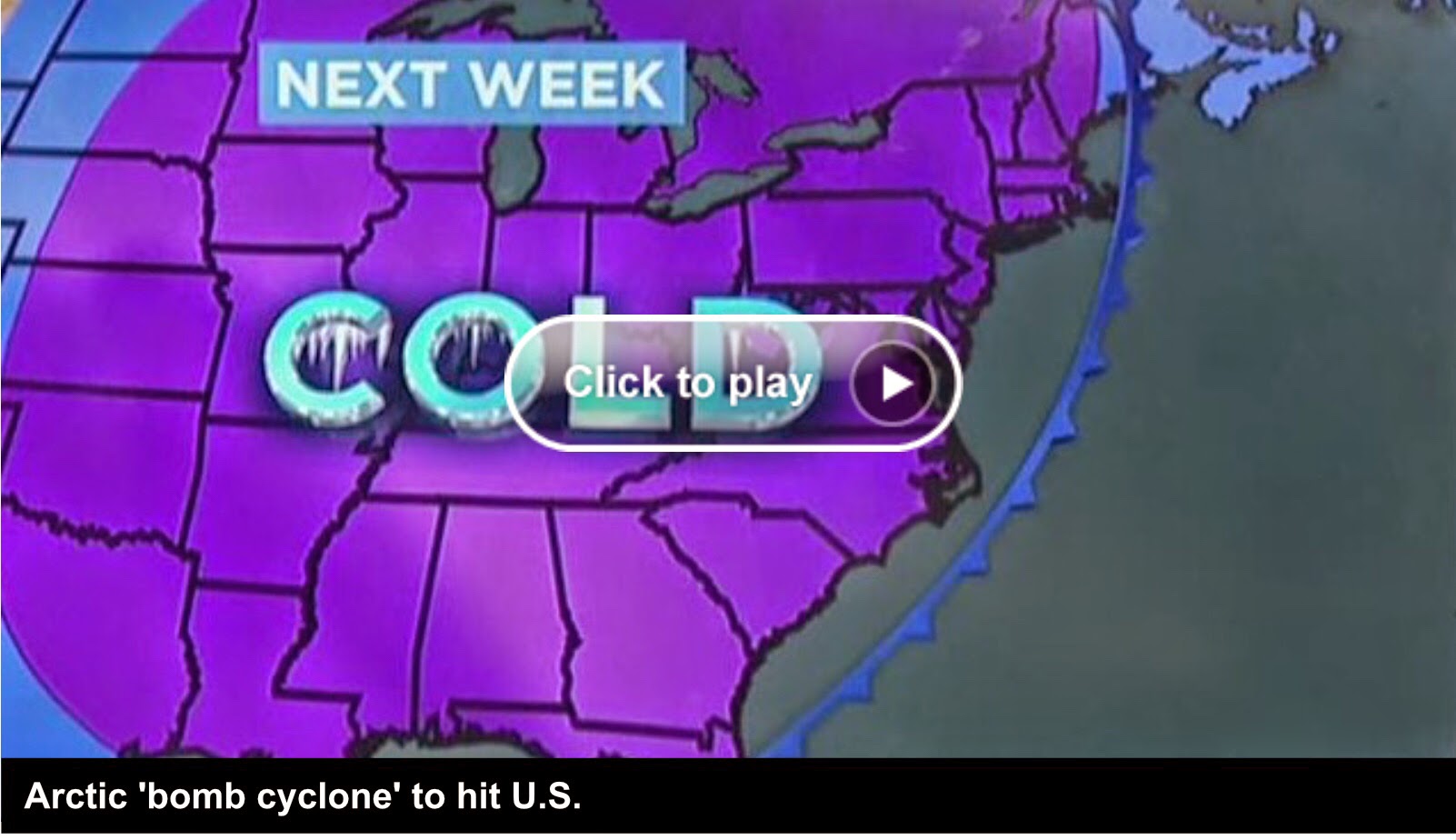
Arctic snap will ice Northern states, whipped down by 'bomb cyclone'

(CNN)The ice man cometh. And does so early this year, after a former Pacific typhoon flew up toward the Arctic and rammed the jet stream.

The stream has whipped south, dragging down frigid air from Canada over the northern Plains and Mountain States and the Upper Midwest, according to the National Weather Service.

It is already plunging temperatures below freezing there and will hammer them into the teens and single digits in many places by midweek, even lower in others.

Great Falls, Montana, will shiver at 9 below zero on Tuesday night.

It’s the coldest weather of the season, the weather service said.

Minneapolis could soon get a foot of snow, the service said, with the Minnesota city experiencing below-freezing temperatures that could last for eight days.

Let it snow

The snap is forecast to lay down the first broad layer of wintry snow, flurries, sleet or ice — long before winter starts — from Montana down to Nebraska and over to Wisconsin.

It will accumulate in inches in the northern Rockies, northern Plains and Great Lakes.

People farther south will also shiver. "Much of the nation east of the Rockies is expected to see a major pattern change by the beginning of the work week," the weather service said.

The western Dakotas are also forecast to get significant snow.

Lows will drop to freezing in Kansas City late Monday, then into the 20s a night later. The snap will stop short, leaving much of the Deep South and Southwest in a fall-like warm zone.

Rain is expected to hit Chicago and Milwaukee on Monday and Tuesday, with a few snowflakes mixed in, according to the service on Sunday afternoon.

Courtesy of Nuri

Residents in the northern United States can thank a whopping tropical cyclone in the Pacific Ocean for the wintry blast.

The remnants of super Typhoon Nuri rolled up north over Alaska’s Aleutian Islands on Friday, kicking off the ripple of Arctic air in the other direction.

Nuri is now the strongest known Northern Pacific cyclone on record, according to the National Weather Service Ocean Prediction Center.

Its remnants plowed into cold air adding violent energy as it went north, similar to what Superstorm Sandy did in the Atlantic two years ago. That earned it the weather moniker "bomb cyclone. More


Monday, September 22, 2014

Whether We Engage or Do Nothing... This Changes Everything

The following is an excerpt taken from the introduction of Naomi Klein's newly published book, This Changes Everything: Capitalism vs. the Climate, and appears at Common Dreams with permission from the book's publisher Simon & Shuster. All rights reserved.

“Most projections of climate change presume that future changes—greenhouse gas emissions, temperature increases and effects such as sea level rise—will happen incrementally. A given amount of emission will lead to a given amount of temperature increase that will lead to a given amount of smooth incremental sea level rise. However, the geological record for the climate reflects instances where a relatively small change in one element of climate led to abrupt changes in the system as a whole. In other words, pushing global temperatures past certain thresholds could trigger abrupt, unpredictable and potentially irreversible changes that have massively disruptive and large-scale impacts. At that point, even if we do not add any additional CO2 to the atmosphere, potentially unstoppable processes are set in motion. We can think of this as sudden climate brake and steering failure where the problem and its consequences are no longer something we can control.” —Report by the American Association for the Advancement of Science, the world’s largest general scientific society, 2014

“I love that smell of the emissions.” — Sarah Palin, 2011

I denied climate change for longer than I care to admit. I knew it was happening, sure. Not like Donald Trump and the Tea Partiers going on about how the continued existence of winter proves it’s all a hoax. But I stayed pretty hazy on the details and only skimmed most of the news stories, especially the really scary ones. I told myself the science was too complicated and that the environmentalists were dealing with it. And I continued to behave as if there was nothing wrong with the shiny card in my wallet attesting to my “elite” frequent flyer status

Climate change is... hard to keep it in your head for very long. We engage in this odd form of on-again-off-again ecological amnesia for perfectly rational reasons. We deny because we fear that letting in the full reality of this crisis will change everything. And we are right."

A great many of us engage in this kind of climate change denial. We look for a split second and then we look away. Or we look but then turn it into a joke (“more signs of the Apocalypse!”). Which is another way of looking away.

Or we look but tell ourselves comforting stories about how humans are clever and will come up with a technological miracle that will safely suck the carbon out of the skies or magically turn down the heat of the sun. Which, I was to discover while researching this book, is yet another way of looking away.

"Climate change is... hard to keep it in your head for very long. We engage in this odd form of on-again-off-again ecological amnesia for perfectly rational reasons. We deny because we fear that letting in the full reality of this crisis will change everything. And we are right."

Or we look but try to be hyper-rational about it (“dollar for dollar it’s more efficient to focus on economic development than climate change, since wealth is the best protection from weather extremes”)—as if having a few more dollars will make much difference when your city is underwater. Which is a way of looking away if you happen to be a policy wonk. Or we look but tell ourselves we are too busy to care about something so distant and abstract—even though we saw the water in the subways in New York City, and the people on their rooftops in New Orleans, and know that no one is safe, the most vulnerable least of all. And though perfectly understandable, this too is a way of looking away.

Or we look but tell ourselves that all we can do is focus on ourselves. Meditate and shop at farmers’ markets and stop driving—but forget trying to actually change the systems that are making the crisis inevitable because that’s too much “bad energy” and it will never work. And at first it may appear as if we are looking, because many of these lifestyle changes are indeed part of the solution, but we still have one eye tightly shut.

Or maybe we do look—really look—but then, inevitably, we seem to forget. Remember and then forget again. Climate change is like that; it’s hard to keep it in your head for very long. We engage in this odd form of on-again-off-again ecological amnesia for perfectly rational reasons. We deny because we fear that letting in the full reality of this crisis will change everything. And we are right.

We know that if we continue on our current path of allowing emissions to rise year after year, climate change will change everything about our world. Major cities will very likely drown, ancient cultures will be swallowed by the seas, and there is a very high chance that our children will spend a great deal of their lives fleeing and recovering from vicious storms and extreme droughts. And we don’t have to do anything to bring about this future. All we have to do is nothing. Just continue to do what we are doing now, whether it’s counting on a techno-fix or tending to our gardens or telling ourselves we’re unfortunately too busy to deal with it.

All we have to do is not react as if this is a full-blown crisis. All we have to do is keep on denying how frightened we actually are. And then, bit by bit, we will have arrived at the place we most fear, the thing from which we have been averting our eyes. No additional effort required.

There are ways of preventing this grim future, or at least making it a lot less dire. But the catch is that these also involve changing everything. For us high consumers, it involves changing how we live, how our economies function, even the stories we tell about our place on earth. The good news is that many of these changes are distinctly un-catastrophic. Many are downright exciting. But I didn’t discover this for a long while.

"All we have to do is not react as if this is a full-blown crisis. All we have to do is keep on denying how frightened we actually are. And then, bit by bit, we will have arrived at the place we most fear, the thing from which we have been averting our eyes. No additional effort required."

I remember the precise moment when I stopped averting my eyes to the reality of climate change, or at least when I first allowed my eyes to rest there for a good while. It was in Geneva, in April 2009, and I was meeting with Bolivia’s ambassador to the World Trade Organization (WTO), who was then a surprisingly young woman named Angélica Navarro Llanos. Bolivia being a poor country with a small international budget, Navarro Llanos had recently taken on the climate portfolio in addition to her trade responsibilities. Over lunch in an empty Chinese restaurant, she explained to me (using chopsticks as props to make a graph of the global emission trajectory) that she saw climate change both as a terrible threat to her people—but also an opportunity.

A threat for the obvious reasons: Bolivia is extraordinarily dependent on glaciers for its drinking and irrigation water and those white-capped mountains that tower over its capital were turning gray and brown at an alarming rate. The opportunity, Navarro Llanos said, was that since countries like hers had done almost nothing to send emissions soaring, they were in a position to declare themselves “climate creditors,” owed money and technology support from the large emitters to defray the hefty costs of coping with more climate-related disasters, as well as to help them develop on a green energy path.

She had recently given a speech at a United Nations climate conference in which she laid out the case for these kinds of wealth transfers, and she gave me a copy. “Millions of people,” it read, “in small islands, least developed countries, landlocked countries as well as vulnerable communities in Brazil, India and China, and all around the world—are suffering from the effects of a problem to which they did not contribute. . . . If we are to curb emissions in the next decade, we need a massive mobilization larger than any in history. We need a Marshall Plan for the Earth. This plan must mobilize financing and technology transfer on scales never seen before. It must get technology onto the ground in every country to ensure we reduce emissions while raising people’s quality of life. We have only a decade.” More
 

Monday, May 26, 2014

Mega dry spell Spain's worst in 150 years

Parts of Spain are currently suffering through their most intense dry spell in a century and a half with Valencia and Alicante among the worst affected regions. Future predictions are not too rosy either, meteorologists warn.

The last eight months have been brutally dry for large swathes of southern and eastern Spain.

While huge storms buffeted Spain's Atlantic coasts and the Canary Islands during the winter and spring, Valencia and Alicante, as well as areas including Murcia, parts of Albacete province, and the Andalusian provinces of Jaén, Almería, Cadíz and Málaga have all been starved of rain.

In the last 150 years, there has never been "such a long and intense drought", according to the country's meteorological agency Aemet.

Indeed there are parts of the country where during "the second worst period of drought on record there was twice as much rain as now", meteorologist José Antonio Maldonado told Spanish free daily 20 minutos.

Rainfall levels in many areas have been less than half of those seen from 1971 to 2000, while some places have seen less than 25 percent of those levels.

Most dams are still at somewhere between 74 percent and 90 percent of capacity thanks to rains from earlier years, but some farmers are already struggling to water their crops, or have gone out of business.

Spain is also facing an uncertain water future: a 2013 study by the Spanish National Research Council (CSIC) looking at the period from 1945 to 2005 found the country's droughts were becoming more intense and more regular. More


    Friday, March 28, 2014

    Nobel Laureates Speak Out

    On Wednesday, 17 Nobel laureates who gathered in Stockholm have published a remarkable memorandum, asking for “fundamental transformation and innovation in all spheres and at all scales in order to stop and reverse global environmental change”. The Stockholm Memorandum concludes that we have entered a new geological era: the Anthropocene, where humanity has become the main driver of global change. The document states:

    Mario Molina signs the Stockholm Memorandum

    Science makes clear that we are transgressing planetary boundaries that have kept civilization safe for the past 10,000 years. [...] We can no longer exclude the possibility that our collective actions will trigger tipping points, risking abrupt and irreversible consequences for human communities and ecological systems. We cannot continue on our current path. The time for procrastination is over. We cannot afford the luxury of denial.

    The memorandum results from a 3-day symposium (attended also by the king of Sweden) on the intertwined problems of poverty, development, ecosystem deterioration and the climate crisis. In the memorandum, the Nobel laureates call for immediate emergency measures as well as long-term structural solutions, and they give specific recommendations in eight key priority areas. For example in climate policy, they recommend to:

    Keep global warming below 2ºC, implying a peak in global CO2 emissions no later than 2015 and recognise that even a warming of 2ºC carries a very high risk of serious impacts and the need for major adaptation efforts.

    The memorandum was handed over to the members of the UN high-level panel on global sustainability, who traveled to Stockholm in order to discuss it with the Nobel laureates and experts at the symposium.

    P.S. As a little reminder of the ongoing work of the merchants of doubt, a small band of five or six “climate sceptic” protesters were gathered outside the symposium, some of whom flown in from Berlin. Their pamphlet identified them as part of the longstanding anti-climate-science campaign of US billionaire Lyndon Larouche and claimed that climate change is “a hoax” and an “insane theory”, the global temperature measurements are “mere lies”, the Nobel laureates meeting “a conspiracy” and the Stockholm Memorandum a “Fascist Manifesto”. I approached one of the protesters who carried a banner “against Green fascism” and asked him whether he seriously believes what his pamphlet says, namely that our meeting is a “symposium for global genocide”. He nodded emphatically and replied: “Yes, of course!” More

    Stockholm Memorandum signing ceremony


    Signing and handing over of the Stockholm Memorandum to the UN High Level Panel on Global Sustainability.

    Tuesday, March 11, 2014

    New NASA Study Warns Of Climate Change’s Pace

    CAPE CANAVERAL (CBSMiami) – NASA jumped back into the discussion of global climate change Tuesday with a new study that showed Earth’s climate will experience roughly 20 percent more warming than estimates originally stated, despite a recent slowdown.

    NASA said the new predictions were based on more detailed calculations of the sensitivity of Earth’s climate to factors like greenhouse gas emissions, which help warm the planet.

    Global temperatures have risen at a rate of 0.22 degrees Fahrenheit per decade since 1951. But according to NASA, since 1998 the rate slowed to 0.09 per decade, despite an increase in some greenhouse gases like carbon dioxide.

    Some studies have since suggested greenhouse gases may not impact Earth as much as previously thought. The Intergovernmental Panel on Climate Change agreed and slightly lowered the range of Earth’s potential warming.

    The new research focused on what’s called Earth’s “transient climate response.” This measurement looks at how temperatures will change as carbon dioxide increases until the total amount of carbon dioxide has doubled.

    Previous estimates put the transient climate response at anywhere from 1.8 degrees to 2.52 degrees Fahrenheit. According to NASA’s new study, the transient climate response is approximately 3.06 degrees and not likely to fall below 2.34 degrees Fahrenheit.

    The study focused on looking at how aerosols from natural sources like volcanoes and wildfire combined with manufacturing activities, cars, and energy production interacted. NASA said depending on the make-up of the aerosols, some cause warming and some cause cooling.

    According to the study, the Northern Hemisphere will likely see more of an impact from aerosols as most man-made aerosols are released from industrial zones north of the equator and most of Earth’s landmasses are in the Northern Hemisphere.

    “I kept thinking, we know the Northern Hemisphere has a disproportionate effect, and some pollutants are unevenly distributed,” the study’s author, climatologist Drew Shindell said. “But we don’t take that into account. I wanted to quantify how much the location mattered.”

    Shindell said that based on his calculations, industrialized countries must reduce greenhouse gas emissions at the higher end of proposed restrictions to avoid the most damaging consequences of climate change. More


    Wednesday, March 5, 2014

    Extreme weather is 'silver lining' for climate action: Christiana Figueres

    Devastating extreme weather including recent flooding in England, Australia's hottest year on record and the US being hit by a polar vortex have a "silver lining" of boosting climate change to the highest level of politics and reminding politicians that climate change is not a partisan issue, according to the UN's climate chief. Christiana Figueres said that it was amoral for people to look at climate change from a politically partisan perspective, because of its impact on future generations.

    The "very strange" weather experienced across the world over the last two years was a sign "we are [already] experiencing climate change," the executive secretary of the UN climate secretariat told the Guardian.

    The flooding of thousands of homes in England because of the wettest winter on record has brought climate change to the forefront of political debate in the UK. The pprime minister, David Cameron, when challenged by Labour leader, Ed Miliband, on his views on man-made climate change and having climate change sceptics in his cabinet, said last week: "I believe man-made climate change is one of the most serious threats that this country and this world faces."

    Climate change was barely mentioned at all in the 2012 US election battle until superstorm Sandy struck New York, prompting the city's then mayor, Michael Bloomberg, to endorse Barack Obama's candidacy because he would "lead on climate change."

    Figueres said: "There's no doubt that these events, that I call experiential evidence of climate change, does raise the issue to the highest political levels. It's unfortunate that we have to have these weather events, but there is a silver lining if you wish, that they remind us is solving climate change, addressing climate change in a timely way, is not a partisan issue."

    She added: "We are reminded that climate change events are for everyone, they're affecting everyone, they have much, much longer effects than a political cycle. Frankly, they're intergenerational, so morally we cannot afford to look at climate change from a partisan perspective."

    Figueres said that examples of recent extreme weather around the world were a sign climate change was here now. "If you take them individually you can say maybe it's a fluke. The problem is it's not a fluke and you can't take them individually. What it's doing is giving us a pattern of abnormality that's becoming the norm. These very strange extreme weather events are going to continue in their frequency and their severity … It's not that climate change is going to be here in the future, we are experiencing climate change."

    Figueres was speaking in London before meeting businesses including Unilever, Lafarge and Royal Dutch Shell to urge them to put pressure on governments to take action on climate change, ahead of renewed international negotiations in Bonn next week to flesh out details of a draft climate treaty to be laid out in Lima this year and agreed in Paris at the end of 2015.

    "2014 is a crucial year because of the timing of next year, [in 2015] there will be very little time work on the actual agreement. We have to frontload the work," she said.

    Peru's foreign minister told the Guardian in January that the Lima meeting in December must produce a first draft of a deal to cut carbon emissions, which will be the first of its kind after efforts to get legally binding agreement for cuts from most of the world's countries failed at a blockbuster meeting in Copenhagen in 2009.

    Asked if a bad deal was better than no deal next year, she said: "Paris has to reach a meaningful agreement because, frankly, we are running out of time."

    But she dismissed parallels with the run-up to the Copenhagen summit, saying the frequency of extreme weather events, lower renewable energy costs and progress on climate legislation at a national level meant it was different this time round.

    "I hope that we don't need too many more Sandys or Haiyans or fires in Australia or floods in the UK to wake us up. My sense is there is already much momentum.We have 66 governments that have climate legislation, we have a total of 500 laws around the world on climate, whereas before Copenhagen we only had 47."

    But the grouping of the world's 47 "least developed" countries said this week that they would want far more money to adapt their economies to climate change than the $100bn a year that been so far proposed by rich countries.

    "We will want more than the $100bn to agree to a new Paris protocol," said Quamrul Choudhury, a lead negotiator for the group which includes many African and Asian countries. "On top of that we will want a legal mechanism to compensate for 'loss and damage' [compensation for extreme climate change events]. There should definitely be some space in the [final] treaty for that," he said in London.

    He called on rich countries to compromise. "The battle lines are drawn. Everyone wants to defend their country and nobody will give an inch, but everyone has to make some sacrifice or we won't have a deal. We need high-level political commitment to raise ambition."

    Choudhury, who is also Bangladesh's climate envoy to the United Nations, met British climate negotiators ahead of the Bonn talks. "I am optimistic that the world can avoid another diplomatic disaster like Copenhagen in 2009. There have been major changes since then. In 2008-09 we knew it would be very expensive to reduce emissions. Now we know it does not cost very much. It's not expensive, not a Herculean task. Countries like the UK know they can reduce emissions by 65% without it costing very much at all.

    "But even if we have an ambitious mitigation target [to cut emissions] adaptation must be the cornerstone of a new treaty. This is not a zero-sum game. If we treat it like that there will be no Paris protocol," he said.

    Figueres later agreed that the $100m proposed in 2009 as compensation for poor countries would not be enough for them to build defences and adapt their economies. "It was a figure plucked from a hat … $100bn is not enough [to meet] the mitigation and not at all for the adaptation costs. The International Energy Agency has suggested it may cost $1 trillion over 25 years just for adaptation. $100bn is a freckle on the map of what needs to be invested."

    A major UN climate science panel report to be published at the end of this month will spell out the impacts of climate change on humanity and the natural world.Leaked versions of the report say agricultural production will decline by up to 2% every decade for the rest of the 21st century. More


    Sunday, January 19, 2014

    Farmers worldwide suffer as extreme weather wreaks food havoc

    To address the crisis, farm ministers from around the world are gathering in Berlin Saturday to discuss climate change and food production.

    BOSTON — Volatile weather around the world is taking farmers on a wild ride. Too much rain in northern China damaged crops in May, three years after too little rain turned the world’s second-biggest corn producer into a net importer of the grain. Dry weather in the U.S. will cut beef output from the world’s biggest producer to the lowest level since 1994, following 2013’s bumper corn crop, which pushed America’s inventory up 30 percent. British farmers couldn’t plant in muddy fields after the second-wettest year on record in 2012 dented the nation’s wheat production.

    “Extreme weather events are a massive risk to agriculture,” said Peter Kendall, president of the British National Farmers Union, who raises 3,953 acres of grain crops in Bedfordshire, England. “Farmers can adapt to gradual temperature increases, but extreme weather events have the potential to completely undermine production. It could be drought, it could be too much rain, it could be extreme heat at the wrong time. It’s the extreme that does the damage.”

    Farm ministers from around the world are gathering in Berlin Saturday to discuss climate change and food production at an annual agricultural forum, with a joint statement planned after the meeting.

    Fast-changing weather patterns, such as the invasion of Arctic air that pushed the mercury in New York from an unseasonably warm 55 degrees Fahrenheit on Jan. 6 to a record low of 4 the next day, will only become more commonplace, according to the New York-based Insurance Information Institute. While the world produces enough to provide its 7 billion people with roughly 2,700 calories daily, and hunger across the globe is declining, one in eight people still don’t get enough to eat, some of which can be blamed on drought, the United Nations said.

    “There’s no question, while there’s variability and volatility from year to year, the number and the cost of catastrophic weather events is on the rise, not just in the U.S., but on a global scale,” said Robert Hartwig, an economist and president of the insurance institute. “It’s all but certain that the size and the magnitude and the frequency of disaster losses in the future is going to be larger than what we see today.”

    The number of weather events and earthquakes resulting in insured losses climbed last year to 880, 40 percent higher than the average of the last 30 years, according to Munich Re, the world’s largest reinsurer.

    Research points to a culprit: an increase in greenhouse gases, generated by human activity, that are forcing global temperatures upward, said Thomas Peterson, principal scientist at the U.S. National Climatic Data Center in Asheville, N.C. The warmer the air the more water it can hold, he said.

    “What we’re finding worldwide is that heavy precipitation is increasing,” Peterson said.

    Flood waters in Passau, Germany, in May and June reached the highest level since 1501, Munich Re said. That was the year Michelangelo first put a chisel to the block of marble that would become his sculpture of David. High water did $15.2 billion in damage in parts of Central and Eastern Europe, according to Munich Re.

    A July hailstorm in Reutlingen, Germany, led to $3.7 billion in insured losses, according to Munich Re. Hailstones the size of babies’ fists cracked the windshield of Marco Kaschuba’s Peugeot.

    “Two minutes before the storm started you could already hear a very loud noise,” said Kaschuba, a 33-year-old photographer. “That was from hailstones hitting the ground in the distance and coming closer.”

    In 2012, Britain had its second-highest rainfall going back to 1910, according to Britain’s meteorology office. England and Wales had its third-wettest year since 1766. More


    Tuesday, October 22, 2013

    Chinese climate expert Dr. Qin Dahe has received the Volvo Group’s Environment Prize 2013

    Chinese climate expert Dr. Qin Dahe has received the Volvo Group’s Environment Prize 2013, which has a prize sum of 1.5 million kronor.

    Dr. Qin Dahe

    Dr. Qin is one of the key contributors to the new reports from the UN climate panel (IPPC). He also attracted wide attention last year for his report on how climate change leads to more extreme weather events.

    The report was the first to scientifically show that extreme weather and climate phenomena have become more frequent over the last 50 years. The findings showed a clear connection between climate change and periods of extreme conditions, such as extended droughts and heat waves, as well as torrential storms and rains.

    The Volvo Award Jury called the report “a game-changer”, and wrote in its motivation: “the report demonstrated for the first time a clear link between climate change and many extreme events, an issue of immediate relevance for human well-being in many parts of the world”.

    Dr Qin is also a leading expert on cryosphere in central high Asia and its importance. The cryosphere is one of the main components of the Earth’s climate system, comprising snow, river and lake ice, sea ice, glaciers, ice shelves, and frozen ground. Especially, glaciers have important impacts on water resources and ecosystems for more than two billion people in Asia.

    Dr Qin has led several scientific expeditions to the Himalayas, and also been on expeditions to the Antarctic.

    “There is no doubt that the major part of the glaciers in the Himalayas is disappearing fast. But one of the research areas we will tackle is the question of whether the Greenland ice cap is stable or not. And as well, the risks for more extreme occurrences such as drought, floods and storms,” said Dr Qin in a statement from Volvo Group.

    The prize will be handed out at a ceremony in Stockholm on November 26. More


    Wednesday, October 16, 2013

    Extreme weather can be the 'most important cause of poverty'

    New research suggests that extreme weather events will keep people poor in many parts of the world.

    The authors argue that where disasters like drought are prevalent, they can be the most important cause of poverty.

    They say that up to 325 million people will be living in countries highly exposed to natural hazards by 2030.

    If aid is not used to reduce these risks, the progress made in fighting poverty could disappear.

    The report has been compiled by the Overseas Development Institute.

    It examines the relationship between disasters and poverty over the next 20 years, using population projections, climate models and estimations of how governments can cope with extreme events.

    The report suggests that up to a third of a billion people could be living in the 49 countries most exposed to the full range of natural hazards and climate extremes in 2030.

    In sub-Saharan Africa 118 million people in poverty will face extreme events.

    Drought means poverty

    The big weather issues that will face most poor people are drought, extreme rainfall and flooding.

    An analysis of the data from rural Ethiopia and Andhra Pradesh in India suggests that where there is a strong risk of drought, then drought is also the single most important factor in keeping people poor, outstripping ill health or dowry payments.

    "We've often heard that ill health is the biggest cause for impoverishment," said Dr Tom Mitchell, the ODI's head of climate change.

    "But in the data, in drought prone areas, the biggest cause is the drought - in areas exposed to these hazards, they are the key causes of impoverishment."

    Developed countries haven't recognised the role that these extreme weather events have in keeping people poor, he says.

    The big problem is that, at present, money tends to flow in response to disasters, not to prevent them.

    Dr Mitchell says the recent Cyclone Phailin in India is a good example.

    "The very fact that it killed so few people means that the chances of raising big finance for recovery efforts are going to be pretty slim. It has not got the big numbers attached to it," he said.

    "I think there's a direct link between the ability to raise finance and the number of people killed. It's a perverse incentive."

    Part of the problem is that donor countries are not prioritising aid at the countries that need it most, in terms of disaster risk reduction.

    "We've tended to provide much more financial support to a set of middle income countries, who can manage it better like the Philippines, Mexico and Indonesia who made really great strides in protecting their populations," said Dr Mitchell.

    "What we've not done is focus on the poorest countries, the ones most exposed to issues like drought, for example, sub Saharan Africa, we've almost missed it off."

    The authors of the report argue that the way that vulnerable countries spend their money needs reforming too. Too often the money is spent on the capital city or on infrastructure and not on the poorest people. More


    Saturday, October 12, 2013

    At least 5 dead as Cyclone Phailin hits India

    NEW DELHI — A gigantic cyclone, one of the strongest ever to hit the Bay of Bengal, pounded India's eastern cost with heavy winds and rain Saturday, as more than half a million people fled the region.

    Cyclone Phailin

    The Press Trust of India, a local news agency, reported at least 5 people died from heavy rains ahead of the storm. Indian government officials later said early reports of deaths from the storm won't become clear until daybreak Sunday, the Associated Press reported. Hundreds of trees were uprooted before the eye of the storm even made landfall early evening local time and flights, trains and shipping operations were canceled and power shut down in six districts in the coastal area.

    The India Meteorological Department said the cyclone made landfall near Gopalpur, India, with sustained winds of 124 mph — equivalent to a Category 3 hurricane.

    Cyclone Phailin caused one of the largest evacuation operations in Indian history, with 600,000 people moved to higher ground in the coastal state of Odisha, which is expected to bear the brunt of the storm.

    Electricity had been cut off in the entire state as a precaution, said Indian navy retired commodore A.K Patnaik, in Bhubaneshwar, the capital of Odisha, who was reached by phone before he shut it down to conserve power.

    "It has been raining very heavily here since yesterday, the streets are flooded, and electricity was shut down this morning," he said. "The streets are empty, everyone is indoors, and people stocked up on groceries and essentials yesterday."

    Satellite images showed the cyclone filling nearly the entire Bay of Bengal, an area larger than France that has seen the majority of the world's worst recorded storms, including a 1999 cyclone that killed 10,000.

    "If it's not a record, it's really, really close," University of Miami hurricane researcher Brian McNoldy told The Associated Press. "You really don't get storms stronger than this anywhere in the world ever."

    To compare it to killer U.S. storms, McNoldy said Phailin is nearly the size of Hurricane Katrina, which killed 1,200 people in 2005 and caused devastating flooding in New Orleans, but also has the wind power of 1992's Hurricane Andrew, which packed 265 kph (165 mph) winds at landfall in Miami.

    "The storm has the potential to cause huge damage," L.S. Rathore, director-general of the Indian Meteorlogical Department told reporters.

    The epicenter of the cyclone is likely to be close to the major port of Paradip in Odisha.

    "We have stopped all cargo operations," Paradip Port Trust Chairman Sudhanshu Shekhara Mishra told the Press Trust of India, a local news agency. "We have set up control rooms and are ready with a contingency plan. We have cleared all vessels. People have been evacuated from low-lying areas."

    The state has created 800 shelters as government workers and volunteers put together food packages for relief camps.

    "I don't want people to panic," said Naveen Patnaik, chief minister of Odisha told PTI, calling for everyone to do their part in helping relief operations. More


    Wednesday, October 9, 2013

    Namibia battles worst drought in decades

    Opuwo, Namibia - The Tjikundi family sits around a small fire boiling a tin pot filled with water and maize - the only food that's available this day. A band of children crawl about, chewing on plastic tubing, and chase the visitors with animated curiosity.

    The homestead is spectacular in its bareness. Soft, dry sand interrupted only by rocks and boulders fashion a molten envy for a lighter, brighter time. The livestock kraal is empty. So too are the granaries.

    Scraggy roosters gawk and peck at the dust with fraught expectation while a domestic cat, at total odds with the environment, purrs and curls around people's ankles.

    "This year is very bad because we have lost all our cattle," Mukaokondunga Tjikundi, in her early 20s, told Al Jazeera. "Sometimes the children go to bed with empty stomachs. Sometimes they just drink some water and go to sleep."

    Hunger and hardship are recurring themes in Kunene, the northwest province in Namibia, considered the hardest-hit region by a drought many consider the worst in decades.

    Almost one million people out of Namibia’s 2.3 million population face moderate to serious levels of food insecurity. The Namibian government in May estimated this year's harvest would yield 42 percent less than 2012.

    In Kunene, two years of failed rains have devastated millet and maize plantations, dried up watering holes for livestock, and forced a population to search for precarious water supplies. Animals drink stagnant water in dry riverbeds, while some Namibians dig for water across the province and guard any source found with little wooden fences.

    'Catastrophe'

    "If people can resort to [drinking] dirty water, more are likely to suffer from water-borne diseases and the health situation is likely to deteriorate for animals and humans," Jack Ndemena, water and sanitation officer with the International Federation of Red Cross and Red Crescent Societies (IFRC), told Al Jazeera.

    "There is nothing and if the rains don’t come, it is going to be a catastrophe."

    In May, Namibian President Hifikepunye Pohamba was forced to declare a state of emergency and requested $33.7 million in international support to avert a crisis. Recognising the strain across the country, the IFRC and UNICEF launched appeals for $1.2m and $7.4m, respectively.

    President Hifikepunye Pohamba has appealed for aid [EPA]

    But little aid has arrived.

    On September 2, Algeria donated $1m in food aid but the reaction from the rest of the international community has been poor.

    Experts say Namibia’s status as a middle-income country hasn’t helped its appeals. Despite its wealth, the country suffers from high levels of income inequality. One-third of the population lives on less than $1 a day, and Namibia ranked 120 out of 187 countries on the 2012 UNDP Human Development Index.

    Malnutrition is the second-most common cause of death recorded for children under five, even in non-drought years. And with the onset of this year’s drought, an estimated 109,000 children under five are at risk of acute malnutrition.

    "Namibia still does not feed itself, and the middle-income classification comes from livestock, mining and fisheries industries - [this] does not provide an accurate situation on the ground," Cousins Gwanama, head of the Department of Crop Sciences at the University of Namibia in Windhoek, told Al Jazeera.

    And it is unlikely the situation is about to get better.

    'Confused'

    With little rainfall predicted for later this year, farmers have described the drought as among the harshest in a generation. Granaries are empty as few crops were planted last year. With plateaus unsuitable for grazing, many pastoralist farmers have been forced to leave their homes and families and herd their livestock to higher ground with more vegetation, often involving a few days’ walk.

    Accustomed to little rainfall, farmers have survived in semi-arid regions of Namibia for decades. But the total absence of precipition has left many perplexed and concerned, their farms lurching towards economic ruin.

    "I thought we understood the environment, nature, but we are almost confused and don’t know what to expect," farmer Toivo Ruhozu told Al Jazeera.

    "If the government doesn’t help, we will just have to face death." More


    Saturday, September 28, 2013

    Human Influence On Climate Clear, IPCC Report Says

    It is extremely likely that human influence has been the dominant cause of the observed warming since the mid-20th century. The evidence for this has grown, thanks to more and better observations, an improved understanding of the climate system response and improved climate models.

    Warming in the climate system is unequivocal and since 1950 many changes have been observed throughout the climate system that are unprecedented over decades to millennia. Each of the last three decades has been successively warmer at Earth's surface than any preceding decade since 1850, reports the Summary for Policymakers of the IPCC Working Group I assessment report, Climate Change 2013: the Physical Science Basis, approved on Friday by member governments of the IPCC in Stockholm, Sweden.

    "Observations of changes in the climate system are based on multiple lines of independent evidence. Our assessment of the science finds that the atmosphere and ocean have warmed, the amount of snow and ice has diminished, the global mean sea level has risen and the concentrations of greenhouse gases have increased," said Qin Dahe, Co-Chair of IPCC Working Group I.

    Thomas Stocker, the other Co-Chair of Working Group I said: "Continued emissions of greenhouse gases will cause further warming and changes in all components of the climate system. Limiting climate change will require substantial and sustained reductions of greenhouse gas emissions."

    "Global surface temperature change for the end of the 21st century is projected to be likely to exceed 1.5°C relative to 1850 to 1900 in all but the lowest scenario considered, and likely to exceed 2°C for the two high scenarios," said Co-Chair Thomas Stocker. "Heat waves are very likely to occur more frequently and last longer. As Earth warms, we expect to see currently wet regions receiving more rainfall, and dry regions receiving less, although there will be exceptions," he added.

    Projections of climate change are based on a new set of four scenarios of future greenhouse gas concentrations and aerosols, spanning a wide range of possible futures. The Working Group I report assessed global and regional-scale climate change for the early, mid-, and later 21st century.

    "As the ocean warms, and glaciers and ice sheets reduce, global mean sea level will continue to rise, but at a faster rate than we have experienced over the past 40 years," said Co-Chair Qin Dahe. The report finds with high confidence that ocean warming dominates the increase in energy stored in the climate system, accounting for more than 90% of the energy accumulated between 1971 and 2010.

    Co-Chair Thomas Stocker concluded: "As a result of our past, present and expected future emissions of CO2, we are committed to climate change, and effects will persist for many centuries even if emissions of CO2 stop."

    Rajendra Pachauri, Chair of the IPCC, said: "This Working Group I Summary for Policymakers provides important insights into the scientific basis of climate change. It provides a firm foundation for considerations of the impacts of climate change on human and natural systems and ways to meet the challenge of climate change." These are among the aspects assessed in the contributions of Working Group II and Working Group III to be released in March and April 2014. The IPCC Fifth Assessment Report cycle concludes with the publication of its Synthesis Report in October 2014.

    "I would like to thank the Co-Chairs of Working Group I and the hundreds of scientists and experts who served as authors and review editors for producing a comprehensive and scientifically robust summary. I also express my thanks to the more than one thousand expert reviewers worldwide for contributing their expertise in preparation of this assessment," said IPCC Chair Pachauri.

    The Summary for Policymakers of the Working Group I contribution to the IPCC Fifth Assessment Report (WGI AR5) is available at www.climatechange2013.org or www.ipcc.ch.