Showing posts with label extreme. Show all posts

Tuesday, January 16, 2018

Climate Code Red:

What we learned about the climate system in 2017 that should send shivers down the spines of policy makers

Much of what happened in 2017 was predictable: news of climate extremes became, how can I put it … almost the norm. There was record-breaking heat on several continents, California’s biggest wildfire (extraordinarily in the middle of winter), an ex-tropical cyclone hitting Ireland (yes, Ireland) in October, and the unprecedented Hurricanes Harvey, Irma and Maria that swept through the Atlantic in August. The US government agency, the NOAA, reported that there were 16 catastrophic billion-dollar weather/climate events in the USA during 2017. Read More

Sunday, November 9, 2014

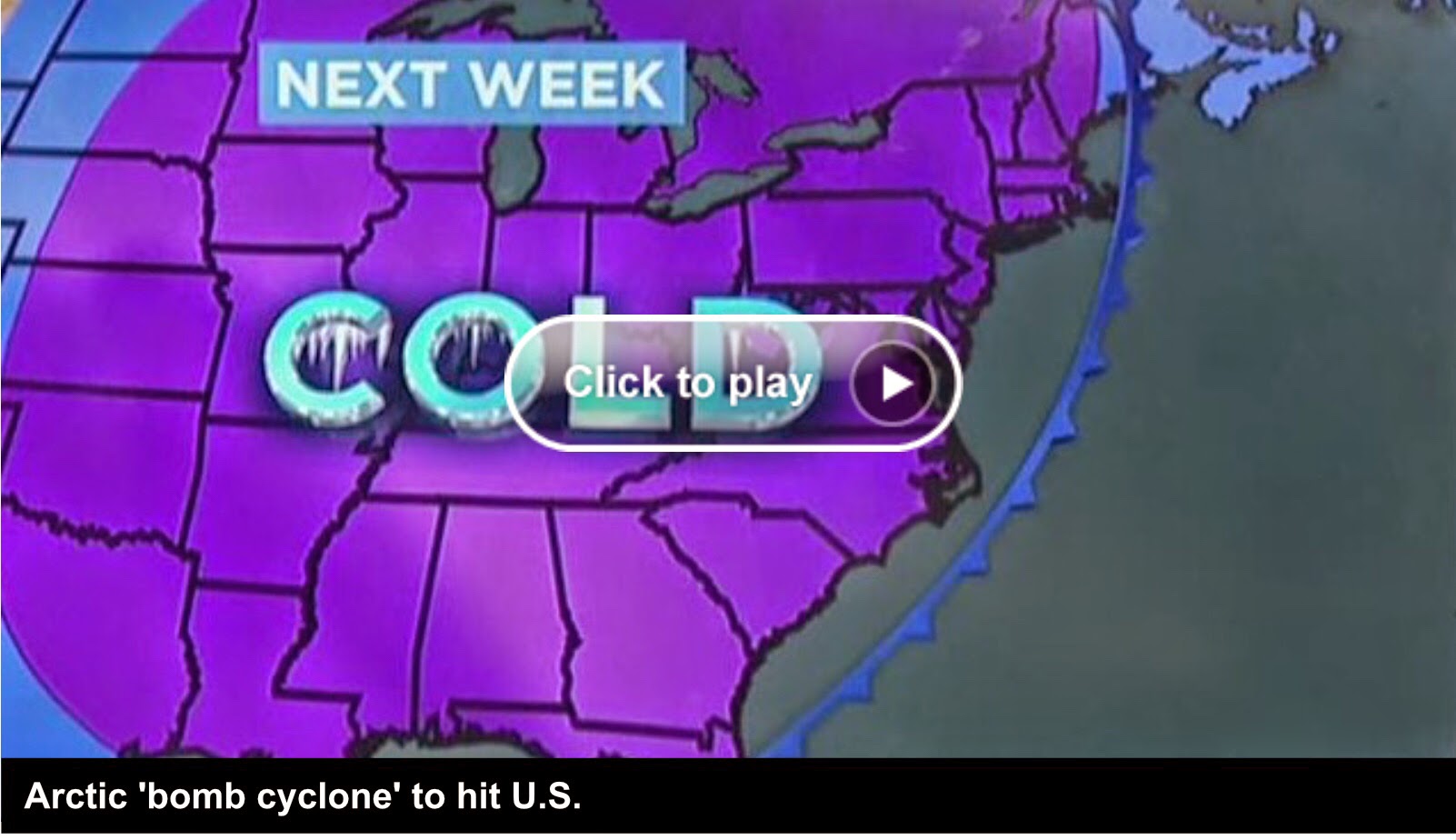
Arctic snap will ice Northern states, whipped down by 'bomb cyclone'

(CNN)The ice man cometh. And does so early this year, after a former Pacific typhoon flew up toward the Arctic and rammed the jet stream.

The stream has whipped south, dragging down frigid air from Canada over the northern Plains and Mountain States and the Upper Midwest, according to the National Weather Service.

It is already plunging temperatures below freezing there and will hammer them into the teens and single digits in many places by midweek, even lower in others.

Great Falls, Montana, will shiver at 9 below zero on Tuesday night.

It’s the coldest weather of the season, the weather service said.

Minneapolis could soon get a foot of snow, the service said, with the Minnesota city experiencing below-freezing temperatures that could last for eight days.

Let it snow

The snap is forecast to lay down the first broad layer of wintry snow, flurries, sleet or ice — long before winter starts — from Montana down to Nebraska and over to Wisconsin.

It will accumulate in inches in the northern Rockies, northern Plains and Great Lakes.

People farther south will also shiver. "Much of the nation east of the Rockies is expected to see a major pattern change by the beginning of the work week," the weather service said.

The western Dakotas are also forecast to get significant snow.

Lows will drop to freezing in Kansas City late Monday, then into the 20s a night later. The snap will stop short, leaving much of the Deep South and Southwest in a fall-like warm zone.

Rain is expected to hit Chicago and Milwaukee on Monday and Tuesday, with a few snowflakes mixed in, according to the service on Sunday afternoon.

Courtesy of Nuri

Residents in the northern United States can thank a whopping tropical cyclone in the Pacific Ocean for the wintry blast.

The remnants of super Typhoon Nuri rolled up north over Alaska’s Aleutian Islands on Friday, kicking off the ripple of Arctic air in the other direction.

Nuri is now the strongest known Northern Pacific cyclone on record, according to the National Weather Service Ocean Prediction Center.

Its remnants plowed into cold air adding violent energy as it went north, similar to what Superstorm Sandy did in the Atlantic two years ago. That earned it the weather moniker "bomb cyclone. More


Sunday, August 24, 2014

450,000 people affected by flooding in E. China

450,000 people affected by flooding in E. China

Published on Aug 22, 2014 • Heavy rainfall hitting east China's Zhejiang Province for over a week has triggered floods and affected 450 thousand people. Hundreds of homes are destroyed and nearly 40 thousand people have been evacuated.

Sunday, August 17, 2014

Wednesday's rainfall a 'once in a 200-year' weather event, climatologists say

Several weather records were broken Wednesday after 13.27 inches of rain fell at Islip Town's Long Island MacArthur Airport in what the Northeast Regional Climate Center calls a 24-hour 200-year storm event.

That means that "rainfall of this magnitude is only expected to occur once in a 200-year period," according to the center's website.

At play was a complex weather system that the National Weather Service had been monitoring for days, warning of the threat of flash flooding, in which an upper level disturbance, a low pressure area at the surface and very moist environment all combined over the area, said Tim Morrin, weather service meteorologist in Upton.

The "bull's-eye" of the heaviest rainfall that deluged an area of western Suffolk was right near MacArthur Airport, he said.

"A very small micro-scale event took place" in that area, one that is yet to be explained, he said, but that will likely be researched extensively, with follow-up papers written. Such a phenomenon is "impossible to forecast," he said, as "there's not enough skill in the computer models to pinpoint that kind of extreme" on such a small scale.

As for hourly rainfall, 5.34 inches fell from 5 to 6 a.m. Wednesday at the airport in Ronkonkoma, followed by another 4.37 inches from 6 to 7 a.m., according to the Climate Center. They may have come back-to-back, but each is considered a 500-year event, said Jessica Spaccio, a climatologist with the center, which is at Cornell University.

Records were also broken, and, "when we break a state record, that's pretty exciting," Spaccio said

According to a preliminary report from the weather service, the previous New York State record for precipitation in a 24-hour period was broken. That was set Aug. 27 to 28, 2011, in Tannersville when 11.6 inches fell during what the service referred to as Hurricane/Tropical Storm Irene.

With half the month still to go, Wednesday's rainfall also resulted in a record for the month of August, previously 13.78 inches set in 1990, the weather service said. The airport's August rainfall now stands at 13.88 inches, said the weather service, which has maintained official records for the airport for the past 30 years.

While Long Island has been considered "abnormally dry" this year by the U.S. Drought Monitor, the 13.27 inches at the airport in just about one day exceeded normal rainfall for June, July and August combined -- 11.68 inches -- based on precipitation records from 1981 to 2010, according to the Climate Center.

Wednesday's rainfall also broke the airport's all-time daily rainfall record, which was 6.74 inches set Aug. 24, 1990, Spaccio said.

And as for the record rainfall for Aug. 13 -- beating that was a piece of cake, with the previous record for that day 0.91 inches, set in 2013, the weather service said.

As for hourly rainfall amounts -- top honors now go to Wednesday from 5 to 6 a.m. when 5.34 inches fell at the airport, followed by 4.37 inches the very next hour, Spaccio said. The highest previous amount was 2.64 inches, which fell in one hour on July 18, 2007. That's based on data maintained since July 1996, she said. More


Friday, March 14, 2014

California Exceptional Drought Worsens

I keep hearing from some people how the storms at the end of February and the start of March had to have helped the California drought.

That all the rain that fell in the lowlands and snow in the Sierra had to have had an impact. Right after the storms in my , I was already pointing out that this was not the case. One set of storms does not end a three-year drought. In that post I stated, "The drought in California did not just develop this year, or in the last 12 months, but over the last three years. It is unrealistic to think one series of storms is going to have a huge impact on the long-term drought..."

Now, two weeks later, here is more evidence that the short period of rain and mountain snow had little impact.

Below is a comparison of the Drought Monitor maps for California from Feb. 18 (before the storms) and the one released today.

Over this span of time the area coverage of D4 drought conditions (exceptional) has actually increased substantially from 14.62 percent to 22.37 percent of the area, covering the rich farming area of the Central Coast to the San Joaquin Valley. The D3-4 area (extreme drought) did come down a little from 68.30 to 65.89, mostly in southwestern California.

I have already shown that many reservoirs in central and northern California are still at near-record low levels. The graph below shows the daily Sierra snowpack this year, compared to the previous two years and to normal.

With no substantial rain and snow expected for at least another week, and a round of near-record temperatures likely in the Central Valley and southwestern California coming for this weekend, all of these stats are not going to get any better. In fact, there is a good chance of below- to well below-normal precipitation over the next couple of weeks.


Sunday, March 9, 2014

America Could Soon Face More Days of “Extreme Rainfall”

Squelch, squelch, squelch – that could be the sound of future America, if predictions about how climate change will ramp up "extreme rainfall" prove accurate.

Say the world's nations do little to reduce the amount of greenhouse gases pouring into the atmosphere. By the years 2041 to 2070, the warmer climate could bring torrential downpours to vast parts of the United States, as shown in this model from NOAA. Dark-blue splashes depict areas that might see as many as two or more days a year of extreme rain, defined as "rainfall totals in excess of the historic 98th percentile." (This is against a 1971 to 2000 baseline.) Cities that should maybe consider wooing the umbrella-manufacturing industry include Seattle, Washington; Portland, Oregon; Boise, Idaho; Richmond, Virginia; and much of the Northeast.

The climate folks at NOAA add:

Climate models project increasing days of extreme rainfall in the Northwest, Midwest, and parts of the Northeast, including some populated coastal areas that are already challenged by inundation and sea level rise. Several major watersheds are predicted to have more days of extreme rainfall by the middle of the century, including the Pacific Northwest, the Ohio River Basin, the Great Lakes, and parts of the Great River and Missouri River Basin. Meanwhile, the Southwest and some other areas frequented by drought are expected to see little difference in the number of extreme rainfall days.

The model is based on the findings of a 2009 national climate assessment, which include the moist bulletin that over the past 50 years precipitation already increased by 5 percent. The bulk of rain falling during especially heavy storms, meanwhile, is thought to have ratcheted up by 20 percent on average in the last century. Scientists generally believe the warming climate will make the northern parts of the country wetter, while the southern and western zones will progressively dry out.

Before anybody interjects, "Can you really sell that while also selling more intense and frequent drought?" – as one Twitter guy just did – NOAA has provided an answer. The agency tweets: "Climate models show that in a warmer world, precip tends to be concentrated into heavier events w/ longer dry periods in btwn." More


Friday, March 7, 2014

We have entered an abrupt climate change phase

The familiar global weather patterns that we, our parents, and our grandparents (and most of our distant ancestors, at least as far back as the last ice age remnants) have always experienced are no more. We have entered an abrupt climate change phase in which an energized water primed atmosphere and disrupted circulation patterns give rise to unfamiliar, massive and powerfully destructive storms, torrential rains, widespread heat waves and droughts, and less commonly but occasionally widespread cold spells.

Why is this happening now? Sophisticated Earth System computer Models (ESMs), summaries of state-of-the-art peer reviewed climate science (Intergovernmental Panel on Climate Change IPCC), and mainstream science have generally put the climate change threat out to the latter part of the century. Global data from all parts of the world, but most noticeably the Arctic shows that reality is quite different from these models and mainstream thinking.

Just by looking out the window much of humanity now senses that something is very different, and uncomfortably wrong in their particular region.

Depending on location, vegetation is drying out and burning, or being toppled by very high wind events, or oceans are invading upon coastlines, or rivers are overrunning banks or drying up or both, while rainfall deluges are inundating other regions. In fact some regions are vacillating between massive floods and massive droughts, or record high temperatures and record low temperatures, even on a weekly basis.

As crazy as things are now, clearly they are not bad enough to wake up the general population enough to vote down denier politicians and demand extensive governmental action on the problem. Not to worry, that action is a sure bet in the near future, the only question is will it happen next year, or in 3 years?

In the meantime, many of us are doing as much as we can to educate people on the dangers we face and speed up the understanding of climate reality process. As much as we do, ultimately it is the hammer of extreme weather, causing, for example global crop failures or taking out a few more cities in rich countries that will take the final credit for an abrupt tipping point in human behavior.

The key to the disruption in the climate system is the Arctic

Human emissions have inexorably increased levels of carbon dioxide and methane (Greenhouse gases GHGs) in the atmosphere sufficiently to cause an incremental overall increase of global mean surface temperature by 0.8 degrees C over the last century. Over the last 3 decades, the GHGs have caused sufficient warming in the Arctic to melt enough land-covered snow and ocean covered ice such that the highly reflective surfaces have been replaced by dark underlying land and ocean greatly increasing sunlight absorption causing Arctic temperature amplification of 3x to 5x and higher.

This has melted permafrost on the land and on the shallow continental shelves and has increased Arctic methane emissions, which on a molecule-to-molecule basis cause warming >150x compared to carbon dioxide on a short timescale. Arctic temperature amplification has reduced the equator-to-Arctic temperature difference, which is responsible for setting up global circulation patterns on the rotating Earth. Thus, the high speed jet stream winds which circumvent the globe become slower, and wavier, and weather patterns change.

Extreme weather events become stronger, more frequent, of longer duration, and act on new regions. In effect, the climate background has changed, so the statistics of all weather events changes. When the ocean tide comes in all boats rise, when the climate system changes all weather events change.

So how does the North American freeze of early January, 2014 and the upcoming late January, 2014 freeze fit into this picture? In our familiar climate, the polar jet stream flowed mostly west to east (with small north-south deviations or waves, with typically 4 to 7 crests and troughs around the globe) separating cold dry Arctic air from lower latitude warmer moist air. The latitude of the jet moves southward in our winter and northward in our summer.

In our present climate the jet stream waviness has greatly increased and eastward average speed has decreased. Not only that, but in early January there were only two troughs (over North America and central Asia) and two crests (over Europe and the Pacific up through Alaska and the Bering Strait).

The troughs had temperatures 20 degrees C cooler than normal, while the crests had temperatures 20 degrees C warmer than normal. These large waves and slowing of the jet stream is directly responsible for the changes we have been experiencing in weather extremes. Cold or warm, depending on your location. More


Wednesday, March 5, 2014

Extreme weather is 'silver lining' for climate action: Christiana Figueres

Devastating extreme weather including recent flooding in England, Australia's hottest year on record and the US being hit by a polar vortex have a "silver lining" of boosting climate change to the highest level of politics and reminding politicians that climate change is not a partisan issue, according to the UN's climate chief. Christiana Figueres said that it was amoral for people to look at climate change from a politically partisan perspective, because of its impact on future generations.

The "very strange" weather experienced across the world over the last two years was a sign "we are [already] experiencing climate change," the executive secretary of the UN climate secretariat told the Guardian.

The flooding of thousands of homes in England because of the wettest winter on record has brought climate change to the forefront of political debate in the UK. The pprime minister, David Cameron, when challenged by Labour leader, Ed Miliband, on his views on man-made climate change and having climate change sceptics in his cabinet, said last week: "I believe man-made climate change is one of the most serious threats that this country and this world faces."

Climate change was barely mentioned at all in the 2012 US election battle until superstorm Sandy struck New York, prompting the city's then mayor, Michael Bloomberg, to endorse Barack Obama's candidacy because he would "lead on climate change."

Figueres said: "There's no doubt that these events, that I call experiential evidence of climate change, does raise the issue to the highest political levels. It's unfortunate that we have to have these weather events, but there is a silver lining if you wish, that they remind us is solving climate change, addressing climate change in a timely way, is not a partisan issue."

She added: "We are reminded that climate change events are for everyone, they're affecting everyone, they have much, much longer effects than a political cycle. Frankly, they're intergenerational, so morally we cannot afford to look at climate change from a partisan perspective."

Figueres said that examples of recent extreme weather around the world were a sign climate change was here now. "If you take them individually you can say maybe it's a fluke. The problem is it's not a fluke and you can't take them individually. What it's doing is giving us a pattern of abnormality that's becoming the norm. These very strange extreme weather events are going to continue in their frequency and their severity … It's not that climate change is going to be here in the future, we are experiencing climate change."

Figueres was speaking in London before meeting businesses including Unilever, Lafarge and Royal Dutch Shell to urge them to put pressure on governments to take action on climate change, ahead of renewed international negotiations in Bonn next week to flesh out details of a draft climate treaty to be laid out in Lima this year and agreed in Paris at the end of 2015.

"2014 is a crucial year because of the timing of next year, [in 2015] there will be very little time work on the actual agreement. We have to frontload the work," she said.

Peru's foreign minister told the Guardian in January that the Lima meeting in December must produce a first draft of a deal to cut carbon emissions, which will be the first of its kind after efforts to get legally binding agreement for cuts from most of the world's countries failed at a blockbuster meeting in Copenhagen in 2009.

Asked if a bad deal was better than no deal next year, she said: "Paris has to reach a meaningful agreement because, frankly, we are running out of time."

But she dismissed parallels with the run-up to the Copenhagen summit, saying the frequency of extreme weather events, lower renewable energy costs and progress on climate legislation at a national level meant it was different this time round.

"I hope that we don't need too many more Sandys or Haiyans or fires in Australia or floods in the UK to wake us up. My sense is there is already much momentum.We have 66 governments that have climate legislation, we have a total of 500 laws around the world on climate, whereas before Copenhagen we only had 47."

But the grouping of the world's 47 "least developed" countries said this week that they would want far more money to adapt their economies to climate change than the $100bn a year that been so far proposed by rich countries.

"We will want more than the $100bn to agree to a new Paris protocol," said Quamrul Choudhury, a lead negotiator for the group which includes many African and Asian countries. "On top of that we will want a legal mechanism to compensate for 'loss and damage' [compensation for extreme climate change events]. There should definitely be some space in the [final] treaty for that," he said in London.

He called on rich countries to compromise. "The battle lines are drawn. Everyone wants to defend their country and nobody will give an inch, but everyone has to make some sacrifice or we won't have a deal. We need high-level political commitment to raise ambition."

Choudhury, who is also Bangladesh's climate envoy to the United Nations, met British climate negotiators ahead of the Bonn talks. "I am optimistic that the world can avoid another diplomatic disaster like Copenhagen in 2009. There have been major changes since then. In 2008-09 we knew it would be very expensive to reduce emissions. Now we know it does not cost very much. It's not expensive, not a Herculean task. Countries like the UK know they can reduce emissions by 65% without it costing very much at all.

"But even if we have an ambitious mitigation target [to cut emissions] adaptation must be the cornerstone of a new treaty. This is not a zero-sum game. If we treat it like that there will be no Paris protocol," he said.

Figueres later agreed that the $100m proposed in 2009 as compensation for poor countries would not be enough for them to build defences and adapt their economies. "It was a figure plucked from a hat … $100bn is not enough [to meet] the mitigation and not at all for the adaptation costs. The International Energy Agency has suggested it may cost $1 trillion over 25 years just for adaptation. $100bn is a freckle on the map of what needs to be invested."

A major UN climate science panel report to be published at the end of this month will spell out the impacts of climate change on humanity and the natural world.Leaked versions of the report say agricultural production will decline by up to 2% every decade for the rest of the 21st century. More


Tuesday, March 4, 2014

Weather in Singapore driest since 1869

The prolonged dry weather affecting Singapore since mid-January has set a new record for the driest month since 1869, according to the National Environment Agency (NEA).

At the Changi climate station, the rainfall total recorded last month was 0.2mm, breaking the previous record of 6.3mm in February 2010.

Apart from being the driest month ever, last month is the most windy month in the last 30 years.

At the Changi climate station, the average daily wind speed of 13.3 kilometre per hour (kph) recorded last month exceeds the previous high of 12.5kph in January 1985.

The prolonged dry conditions have also set a new record for the lowest average daily relative humidity of 74.5%.

The previous record low for February and any month of the year was 76.9% (February 1968) and 74.6% (June 2013).

The last day of significant rainfall was on February 16 when between 0.2mm and 29m was recorded in various parts of the island.

Since then, there has been little or no rainfall, with Singapore entering another period of dry spell on February 17.

The dry weather affecting Singapore and the surrounding region is expected to persist in the first half of this month.

With the expected onset of the inter-monsoon in the second half of this month, the winds in the region will turn light and variable in direction.

Increased rainfall can be expected in the later part of the month.

With the dry weather expected to continue, the National Water Agency has started a public campaign to get everyone to conserve water. – Bernama, March 4, 2014. More


Saturday, March 1, 2014

Mind-blowing view of vigorous California storm

Drought-stricken Southern California is getting doused by a powerhouse storm that looks like a hurricane, except it’s not.

On water vapor imagery, the storm shows off an unmistakable counterclockwise swirl and a well-defined center with an eye-like appearance. But, in reality, this is just a mid-latitude storm – albeit an intense [and potentially dangerous] one. Its lowest central pressure is 975 mb, the equivalent of a category 1 or 2 hurricane. It kind of resembles a cinnamon roll, or a snail.

Here’s another look at the storm via infrared satellite imagery:

And here’s a summary of the impacts expected from the storm, from the National Weather Service in Los Angeles:


Thursday, February 13, 2014

UK storms and floods show climate change is upon us - Lord Stern

The record rainfall and storm surges that have brought flooding across the UK are a clear sign that we are already experiencing the impacts of climate change.

Many commentators have suggested that we are suffering from unprecedented extreme weather. There are powerful grounds for arguing that this is part of a trend.

Four of the five wettest years recorded in the UK have occurred from the year 2000 onwards. Over that same period, we have also had the seven warmest years.

That is not a coincidence. There is an increasing body of evidence that extreme daily rainfall rates are becoming more intense, in line with what is expected from fundamental physics, as the Met Office pointed out earlier this week.

A warmer atmosphere holds more water. Add to this the increase in sea level, particularly along the English Channel, which is making storm surges bigger, and it is clear why the risk of flooding in the UK is rising.

But it is not just here that the impacts of climate change have been felt through extreme weather events over the past few months. Australia has just had its hottest year on record, during which it suffered record-breaking heatwaves and severe bushfires in many parts of the country. And there has been more extreme heat over the past few weeks.

Argentina had one of its worst heatwaves in late December, while parts of Brazil were struck by floods and landslides following record rainfall.

And very warm surface waters in the north-west Pacific during November fuelled Typhoon Haiyan, the strongest tropical cyclone to make landfall anywhere in the world, which killed more than 5,700 people in the Philippines.

This is a pattern of global change that it would be very unwise to ignore.

The Intergovernmental Panel on Climate Change last September pointed to a changing pattern of extreme weather since 1950, with more heatwaves and downpours in many parts of the world, as the Earth has warmed by about 0.7C.

The IPCC has concluded from all of the available scientific evidence that it is 95% likely that most of the rise in global average temperature since the middle of the 20th century is due to emissions of greenhouse gases, deforestation and other human activities.

The upward trend in temperature is undeniable, despite the effects of natural variability in the climate which causes the rate of warming to temporarily accelerate or slow for short periods, as we have seen over the past 15 years.

If we do not cut emissions, we face even more devastating consequences, as unchecked they could raise global average temperature to 4C or more above pre-industrial levels by the end of the century.

This would be far above the threshold warming of 2C that countries have already agreed that it would be dangerous to breach. The average temperature has not been 2C above pre-industrial levels for about 115,000 years, when the ice-caps were smaller and global sea level was at least five metres higher than today.

The shift to such a world could cause mass migrations of hundreds of millions of people away from the worst-affected areas. That would lead to conflict and war, not peace and prosperity.

In fact, the risks are even bigger than I realised when I was working on the review of the economics of climate change for the UK government in 2006. Since then, annual greenhouse gas emissions have increased steeply and some of the impacts, such as the decline of Arctic sea ice, have started to happen much more quickly.

We also under-estimated the potential importance of strong feedbacks, such as the thawing of the permafrost to release methane, a powerful greenhouse gas, as well as tipping points beyond which some changes in the climate may become effectively irreversible.

What we have experienced so far is surely small relative to what could happen in the future. We should remember that the last time global temperature was 5C different from today, the Earth was gripped by an ice age.

So the risks are immense and can only be sensibly managed by reducing greenhouse gas emissions, which will require a new low-carbon industrial revolution.

History teaches us how quickly industrial transformations can occur through waves of technological development, such as the introduction of electricity, based on innovation and discovery.

We are already seeing low-carbon technologies being deployed across the world, but further progress will require investment and facing up to the real prices of energy, including the very damaging emissions from fossil fuels.

Unfortunately, the current pace of progress is not nearly rapid enough, with many rich industrialised countries being slow to make the transition to cleaner and more efficient forms of economic growth.

The lack of vision and political will from the leaders of many developed countries is not just harming their long-term competitiveness, but is also endangering efforts to create international co-operation and reach a new agreement that should be signed in Paris in December 2015.

Delay is dangerous. Inaction could be justified only if we could have great confidence that the risks posed by climate change are small. But that is not what 200 years of climate science is telling us. The risks are huge.

Fortunately poorer countries, such as China, are showing leadership and beginning to demonstrate to the world how to invest in low-carbon growth.

The UK must continue to set an example to other countries. The 2008 Climate Change Act, which commits the UK to cut its emissions by at least 80% by 2050, is regarded around the world as a model for how politicians can create the kind of clear policy signal to the private sector which could generate billions of pounds of investment. Weakening the Act would be a great mistake and would undermine a strong commitment made by all of the main political parties.

Squabbling and inconsistent messages from ministers, as well as uncertainty about the policies of possible future governments, are already eroding the confidence of businesses. Government-induced policy risk has become a serious deterrent to private investment.

Instead, the UK should work with the rest of the European Union to create a unified and much better functioning energy market and power grid structure. This would also increase energy security, lower costs and reduce emissions. What better way is there to bring Europe together?

The government will also have to ensure the country becomes more resilient to those impacts of climate change that cannot now be avoided, including by investing greater sums in flood defences.

It should resist calls from some politicians and parts of media to fund adaptation to climate change by cutting overseas aid. It would be deeply immoral to penalise the 1.2 billion people around the world who live in extreme poverty.

In fact, the UK should be increasing aid to poor countries to help them develop economically in a climate that is becoming more hostile largely because of past emissions by rich countries.

A much more sensible way to raise money would be to implement a strong price on greenhouse gas pollution across the economy, which would also help to reduce emissions. It is essential that the government seizes this opportunity to foster the wave of low-carbon technological development and innovation that will drive economic growth and avoid the enormous risks of unmanaged climate change. More

Nicholas Stern is chair of the Grantham Research Institute on Climate Change and the Environment at the LSE and president of the British Academy.


Tuesday, January 28, 2014

Rare snow, ice storm sends shock throughout Deep South

ATLANTA — A Midwest winter storm roared into the the Deep South on Tuesday, bringing icy rain and sleet to South Texas and threats of a dangerous ice storm and power outages from Louisiana to the Virginia coast.

At the same time, intense cold continued its onslaught across the north-central and northeastern U.S., with wind chill warnings and advisories in place all the way from Montana to Maine.

In the South, snow fell on Alabama-Georgia border Tuesday morning, moving quickly into northwest Atlanta suburbs. Forecasts called for up to a foot of snow in Virginia Beach, Norfolk, Portsmouth and Chesapeake in Virginia and up to 10 inches along much of the North Carolina coast.

Delta Airlines, with headquarters in Atlanta, said 1,850 flights have been canceled systemwide Tuesday beginning at 11 a.m. ET. Of that number, 840 flights from Atlanta were affected.

In the Atlanta area, which was bracing for up to 2 inches of snow, several school systems canceled classes or announced early closings.

“We have preparations from a couple of other close calls the past few weeks,” said Mark McKinnon, a spokesman for the Georgia Department of Transportation. “They’ve just got to come in and crank it up.”

He said crews would likely come in at noon Tuesday and begin pretreating bridges with a salt-brine mixture, and then be on call to battle snow and ice with salt and pea-sized gravel.

The threat of icy roads was particularly alarming in southern cities unequipped for such rare weather, including Austin, Charleston, S.C., Pensacola, Fla., Mobile, Ala., and New Orleans.

“This is a very dangerous situation because snow and ice are very rare for extreme southern Mississippi,” said Robert Latham, executive director of the Mississippi Emergency Management Agency. “We need everyone to have an emergency plan together for this.”

Louisiana Gov. Bobby Jindal declared a state of emergency in the Pelican State because of the threat of heavy snow plus freezing temperatures that could paralyze most roadways.

“It’s important people start preparing now for the storm,” Jindal said late Monday. “We are working to keep open major corridors across the state, but only for those who absolutely must travel.”

In Columbia, S.C., Fort Jackson planned to stop normal operation at mid-morning and keep on only essential personnel.

In Savannah, which is expecting a wintry mix of snow and freezing rain, schools have been closed and residents were “making a run” on grocery stores, said Bret Bell, a city spokesman. He said the main concern was not so much snow as icing on roads.

Appalachian Power asked its customers in Tennessee, Virginia and West Virginia to conserve electricity and minimize the threat of power disruptions during the cold snap.

The utility says PJM Interconnection, which operates the electricity grid for 13 states and the District of Columbia, has issued a call for voluntary conservation on Tuesday because of expected high demand.

The harsh cold pushing into the South is an extension of the hard freeze that has gripped the Midwest for days. Schools in Chicago are closed for a second day.

In Minnesota, most metro schools and the University of Minnesota are closed as wind chills were expected to drop as low as 35 to 50 degrees below zero.

The state was also struggling with a short supply of natural gas in some parts due to a Canadian pipeline explosion.

Xcel Energy asked all customers, including in the Twin Cities, to cut back on natural gas use and hold their home thermostats at 60 degrees. More


Saturday, December 28, 2013

Warm welcome

ABHA — A cold chill is affecting most regions of the Kingdom, especially the highlands of the northern and southern regions. Normal life has also been affected by heavy snowfall and extreme cold weather. In the midst of winter, residents of the Sarawat Mountain ranges in the south are taking shelter in the warmth of Tihama and its beaches along the Red Sea coast.

Tihama Asir draws thousands of picnickers thanks to its warm and pleasant weather. Families in their thousands from various cities and mountainous regions of Asir, Baha and Jazan provinces throng the beaches during the weekend.

Mufreh Yahya Mufreh, a citizen, said local residents from the highlands of Asir are now flocking to Tihama Asir in search of warm weather. They enjoy relaxing on the beaches in Huraidah, Qahma, and Omuq.

Abdullah Al-Qahtani, a resident of Sarat Obaida, said he took his family to the beaches of Tihama Asir in pursuit of its warm and pleasant weather when his native place experiences extreme winter. Abdurahman Al-Abdali, another resident, said that there is huge presence of picnickers in many lower plains of Asir and Jazan such as Huraidah, Qahma, Rijal Alma, Mahayil Asir, Darb, Shaqeeq, Tihama Ballahmar and Ballasmar.

A large number of Saudi youths from Baha and Asir also flock to Tihama in order to enjoy its pleasant weather. They set up tents in open air and stay there overnight. Muqbil Al-Ghamdi, one of them, said that they are following a custom inherited from their elders.

“We came in the company of close friends to enjoy the pleasant weather and beauty of nature, away from the hustle and bustle of city life. We bring all essential things for camping such as food, tents, carpets, lanterns and mosquito nets,” he said while noting that they undertake the trips on the weekend after great planning and preparation.

Hamad Bin Muhammad, another member of the group, said such outings allow people to learn the meaning of community living. “This is a rare opportunity for me to enjoy the beauty of pure nature in the company of intimate friends while sharing ideas and exchanging friendly advice.”

The huge rush of picnickers to Tihama has resulted in considerable increase in the rents of furnished apartments, villas and beach cabins. Speaking to Okaz/Saudi Gazette, several picnickers complained about the steep hikes. One disgruntled visitor said: “Rents of apartments increased two-fold and the rent for a flat with ordinary facilities rose to over SR500 per day. Rates for beach houses are similarly high.”

Yahya Al-Omrani and Saeed Al-Qahtani expressed their displeasure over the insufficient number of accommodations in the coastal regions. Abdullah Al-Zahrani, a native of Abha, said: “I used to go to Qahma and Huraidah in the afternoon and return home early morning mainly because of non-availability of apartments during the weekend.”

Abdullah Matain, executive director of the Saudi Commission for Tourism and Antiquities (SCTA) in Asir, said that the coastal regions are currently witnessing unprecedented growth and development. “Prince Faisal Bin Khaled, Emir of Asir region, laid the foundation stone for several projects, and these included the Asir Beach Resort and seafront projects plus several public utilities for tourists and picnickers,” he added. More