Showing posts with label agriculture. Show all posts

Sunday, November 9, 2014

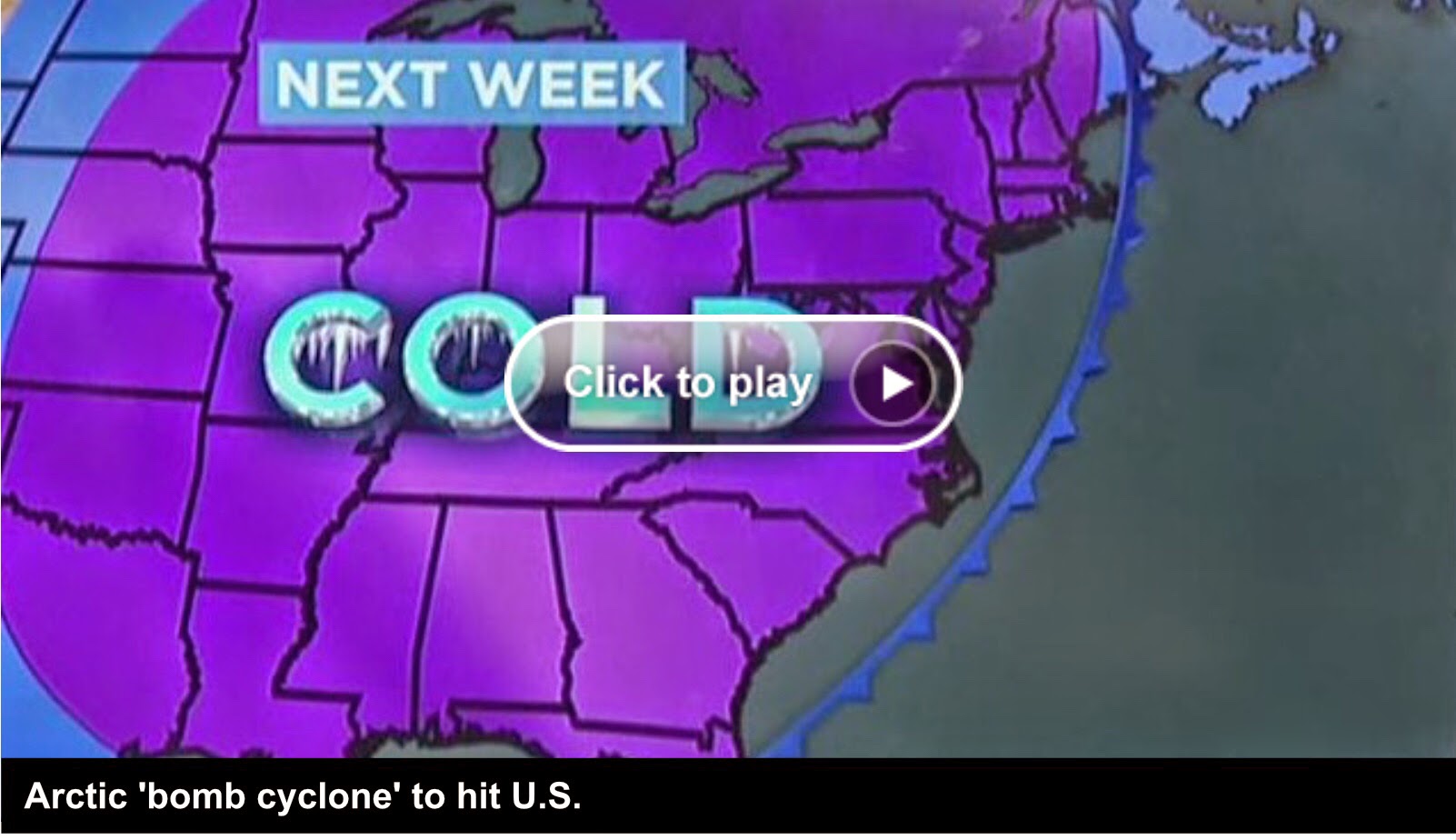
Arctic snap will ice Northern states, whipped down by 'bomb cyclone'

(CNN)The ice man cometh. And does so early this year, after a former Pacific typhoon flew up toward the Arctic and rammed the jet stream.

The stream has whipped south, dragging down frigid air from Canada over the northern Plains and Mountain States and the Upper Midwest, according to the National Weather Service.

It is already plunging temperatures below freezing there and will hammer them into the teens and single digits in many places by midweek, even lower in others.

Great Falls, Montana, will shiver at 9 below zero on Tuesday night.

It’s the coldest weather of the season, the weather service said.

Minneapolis could soon get a foot of snow, the service said, with the Minnesota city experiencing below-freezing temperatures that could last for eight days.

Let it snow

The snap is forecast to lay down the first broad layer of wintry snow, flurries, sleet or ice — long before winter starts — from Montana down to Nebraska and over to Wisconsin.

It will accumulate in inches in the northern Rockies, northern Plains and Great Lakes.

People farther south will also shiver. "Much of the nation east of the Rockies is expected to see a major pattern change by the beginning of the work week," the weather service said.

The western Dakotas are also forecast to get significant snow.

Lows will drop to freezing in Kansas City late Monday, then into the 20s a night later. The snap will stop short, leaving much of the Deep South and Southwest in a fall-like warm zone.

Rain is expected to hit Chicago and Milwaukee on Monday and Tuesday, with a few snowflakes mixed in, according to the service on Sunday afternoon.

Courtesy of Nuri

Residents in the northern United States can thank a whopping tropical cyclone in the Pacific Ocean for the wintry blast.

The remnants of super Typhoon Nuri rolled up north over Alaska’s Aleutian Islands on Friday, kicking off the ripple of Arctic air in the other direction.

Nuri is now the strongest known Northern Pacific cyclone on record, according to the National Weather Service Ocean Prediction Center.

Its remnants plowed into cold air adding violent energy as it went north, similar to what Superstorm Sandy did in the Atlantic two years ago. That earned it the weather moniker "bomb cyclone. More


Friday, March 28, 2014

Nobel Laureates Speak Out

On Wednesday, 17 Nobel laureates who gathered in Stockholm have published a remarkable memorandum, asking for “fundamental transformation and innovation in all spheres and at all scales in order to stop and reverse global environmental change”. The Stockholm Memorandum concludes that we have entered a new geological era: the Anthropocene, where humanity has become the main driver of global change. The document states:

Mario Molina signs the Stockholm Memorandum

Science makes clear that we are transgressing planetary boundaries that have kept civilization safe for the past 10,000 years. [...] We can no longer exclude the possibility that our collective actions will trigger tipping points, risking abrupt and irreversible consequences for human communities and ecological systems. We cannot continue on our current path. The time for procrastination is over. We cannot afford the luxury of denial.

The memorandum results from a 3-day symposium (attended also by the king of Sweden) on the intertwined problems of poverty, development, ecosystem deterioration and the climate crisis. In the memorandum, the Nobel laureates call for immediate emergency measures as well as long-term structural solutions, and they give specific recommendations in eight key priority areas. For example in climate policy, they recommend to:

Keep global warming below 2ºC, implying a peak in global CO2 emissions no later than 2015 and recognise that even a warming of 2ºC carries a very high risk of serious impacts and the need for major adaptation efforts.

The memorandum was handed over to the members of the UN high-level panel on global sustainability, who traveled to Stockholm in order to discuss it with the Nobel laureates and experts at the symposium.

P.S. As a little reminder of the ongoing work of the merchants of doubt, a small band of five or six “climate sceptic” protesters were gathered outside the symposium, some of whom flown in from Berlin. Their pamphlet identified them as part of the longstanding anti-climate-science campaign of US billionaire Lyndon Larouche and claimed that climate change is “a hoax” and an “insane theory”, the global temperature measurements are “mere lies”, the Nobel laureates meeting “a conspiracy” and the Stockholm Memorandum a “Fascist Manifesto”. I approached one of the protesters who carried a banner “against Green fascism” and asked him whether he seriously believes what his pamphlet says, namely that our meeting is a “symposium for global genocide”. He nodded emphatically and replied: “Yes, of course!” More

Stockholm Memorandum signing ceremony


Signing and handing over of the Stockholm Memorandum to the UN High Level Panel on Global Sustainability.

Friday, March 14, 2014

Pakistan’s Impending Famine

Thar, Sindh, Pakistan

It’s hard to catch a break in Pakistan.

Extremist violence is widespread, earthquakes and flooding are routine, and polio remains endemic. No nation has a higher infant mortality rate, and only a few have more cases of tuberculosis. Nearly half the country’s 180 million people lack access to safe water, and many Pakistanis have experienced power outages of up to 20 hours per day. Given such stresses, it’s not surprising that up to 16 percent of the country suffers from mental illness.

And now comes the latest scourge: Famine.

In recent days, media reports have revealed that dozens of people—many of them children—have died from malnutrition over the last three months in the bone-dry desert region of Thar, in the southern province of Sindh. And yet things could soon get much worse. A recent UNICEF report, noting that drought has “devastated” crops and livestock and that “hundreds of thousands” of people have fled, warns of a possible “massive humanitarian crisis” in Thar. Ominously, almost 3 million people “risk starvation” across Pakistan.

Many Pakistani press accounts—and numerous Pakistani politicians—depict the Thar tragedy as a catastrophic case of negligence by Sindh’s provincial government. They fault local officials for taking too long to get food assistance to those in need late last year when drought conditions first began to set in. And they single out authorities for failing to transfer sick children in remote areas to better hospitals.

Yet the Thar famine also reflects another type of failure: that of democracy.

In recent years, Pakistan—a country ruled by the military for about half its existence— has made remarkable democratic progress. With successive free elections, civilian rule is firmly in place. Pakistan’s mighty military has mellowed. Constitutional amendments have decentralized power. The Supreme Court is increasingly targeting powerful people and institutions. And private media outlets have rapidly proliferated.

However, there are limits to this progress.

The most commonly cited obstacles to deeper democratization are the military, which continues to exert heavy influence over politics; a lack of pluralism and tolerance, which contributes to the deplorable plight of religious minorities; and the country’s abysmal law enforcement, which enables militants to operate with impunity.

Yet the tragedy in Thar underscores a more insidious and underreported threat to democracy: Astounding manifestations of land inequality.

In Sindh, a paltry 0.05 percent of households hold more than five acres of land (the figure is similar in Punjab, Pakistan’s most populous province). In the nation as a whole, 2 percent of households own nearly 50 percent of land, while 5 percent of agricultural households own nearly two thirds of Pakistan’s farmland.

This means that the majority of the population holds little to no land. Without land, it’s difficult to access food and water (and it’s also difficult to earn a livelihood; landless Pakistanis make up 70 percent of the country’s rural poor). Most Pakistanis must depend on a tiny, wealthy landowning minority for access to these natural resources.

These resources, and the land that holds them, are becoming increasingly precious. According to one alarming estimate, Pakistan loses three acres of good agricultural land every 20 minutes. In Thar, land and natural resources are further imperiled by Islamabad’s plan to tap into the region’s vast coalfields to ease the country’s severe energy crisis. Officials insist there will be no deleterious impacts on local communities, but there’s good reason to fear that such exploitation could cause environmental distress and displacement, and deprive an impoverished region of a critical natural resource. These are very real problems in equally dry and poor Baluchistan, a province long subjected to intensive natural resource extractions by Islamabad and large corporations. Such conditions have helped fuel a long-running separatist insurgency.

In effect, millions of Pakistanis have neither the land to grow food nor the money to buy it. And yet little is done to help them. Landed rural elites—the essence of vested interests in Pakistan—seemingly spend more time blocking critical agricultural reforms (including those that would increase the tax base) than addressing the plight of the landless. They have also been accused of siphoning off irrigation water flows from poor farmers, and of diverting floodwaters away from their crops and into more vulnerable communities. What’s particularly troubling about all this is that these wealthy landowners are often politically connected, or politicians themselves (Sindh’s landed rural elite is a strong base of support for the Pakistan People’s Party, or PPP, which runs the Sindh government).

Consider the strikingly blasé reactions of local officials to current conditions in Thar. Apparently unmoved by (or oblivious to) UNICEF’s warnings of a massive crisis, PPP leaders have described events of recent days as “normal” and “nothing new.” Sindh’s advocate general, speaking Monday at a hearing convened by Pakistan’s Supreme Court, expressed regret, but also appeared to lay the blame on parents for not taking their kids to the hospital.

Perhaps most egregious of all, after federal officials toured affected areas this week, Sindh’s government hosted a lavish buffet lunch featuring fried fish and biryani —“an act of such monumental stupidity and insensitivity,” according to one Pakistani editorial, “that it beggars belief.”

Call this heartlessness, or call it apathy. Many Pakistanis call it feudalism—the embodiment of a system in which imperious landed elites lord over their hapless subjects. One thing you can’t call it, however, is democracy. Yes, it’s an imperfect institution—but surely it doesn’t sanction such vast disparities in land ownership, or the type of leadership that seems unmoved by the humanitarian crises spawned by those disparities.

The takeaway here is that in Thar, people are dying because of deeply entrenched inequalities that make them profoundly food insecure and hyper-vulnerable to calamities—like drought and disease—that more fortunate people elsewhere can withstand and survive.

Ultimately, the dead and dying of Thar—just like slaughtered Shia Muslims, the military’s large political footprint, and state sponsorship of militancy—underscore the fact that despite considerable achievements in recent years, democracy in Pakistan remains a work in progress.

Michael Kugelman is the senior program associate for South Asia at the Woodrow Wilson International Center for Scholars in Washington, DC. He can be reached at michael.kugelman[@]wilsoncenter.org or on Twitter @michaelkugelman.


California Exceptional Drought Worsens

I keep hearing from some people how the storms at the end of February and the start of March had to have helped the California drought.

That all the rain that fell in the lowlands and snow in the Sierra had to have had an impact. Right after the storms in my , I was already pointing out that this was not the case. One set of storms does not end a three-year drought. In that post I stated, "The drought in California did not just develop this year, or in the last 12 months, but over the last three years. It is unrealistic to think one series of storms is going to have a huge impact on the long-term drought..."

Now, two weeks later, here is more evidence that the short period of rain and mountain snow had little impact.

Below is a comparison of the Drought Monitor maps for California from Feb. 18 (before the storms) and the one released today.

Over this span of time the area coverage of D4 drought conditions (exceptional) has actually increased substantially from 14.62 percent to 22.37 percent of the area, covering the rich farming area of the Central Coast to the San Joaquin Valley. The D3-4 area (extreme drought) did come down a little from 68.30 to 65.89, mostly in southwestern California.

I have already shown that many reservoirs in central and northern California are still at near-record low levels. The graph below shows the daily Sierra snowpack this year, compared to the previous two years and to normal.

With no substantial rain and snow expected for at least another week, and a round of near-record temperatures likely in the Central Valley and southwestern California coming for this weekend, all of these stats are not going to get any better. In fact, there is a good chance of below- to well below-normal precipitation over the next couple of weeks.


Sunday, January 19, 2014

Farmers worldwide suffer as extreme weather wreaks food havoc

To address the crisis, farm ministers from around the world are gathering in Berlin Saturday to discuss climate change and food production.

BOSTON — Volatile weather around the world is taking farmers on a wild ride. Too much rain in northern China damaged crops in May, three years after too little rain turned the world’s second-biggest corn producer into a net importer of the grain. Dry weather in the U.S. will cut beef output from the world’s biggest producer to the lowest level since 1994, following 2013’s bumper corn crop, which pushed America’s inventory up 30 percent. British farmers couldn’t plant in muddy fields after the second-wettest year on record in 2012 dented the nation’s wheat production.

“Extreme weather events are a massive risk to agriculture,” said Peter Kendall, president of the British National Farmers Union, who raises 3,953 acres of grain crops in Bedfordshire, England. “Farmers can adapt to gradual temperature increases, but extreme weather events have the potential to completely undermine production. It could be drought, it could be too much rain, it could be extreme heat at the wrong time. It’s the extreme that does the damage.”

Farm ministers from around the world are gathering in Berlin Saturday to discuss climate change and food production at an annual agricultural forum, with a joint statement planned after the meeting.

Fast-changing weather patterns, such as the invasion of Arctic air that pushed the mercury in New York from an unseasonably warm 55 degrees Fahrenheit on Jan. 6 to a record low of 4 the next day, will only become more commonplace, according to the New York-based Insurance Information Institute. While the world produces enough to provide its 7 billion people with roughly 2,700 calories daily, and hunger across the globe is declining, one in eight people still don’t get enough to eat, some of which can be blamed on drought, the United Nations said.

“There’s no question, while there’s variability and volatility from year to year, the number and the cost of catastrophic weather events is on the rise, not just in the U.S., but on a global scale,” said Robert Hartwig, an economist and president of the insurance institute. “It’s all but certain that the size and the magnitude and the frequency of disaster losses in the future is going to be larger than what we see today.”

The number of weather events and earthquakes resulting in insured losses climbed last year to 880, 40 percent higher than the average of the last 30 years, according to Munich Re, the world’s largest reinsurer.

Research points to a culprit: an increase in greenhouse gases, generated by human activity, that are forcing global temperatures upward, said Thomas Peterson, principal scientist at the U.S. National Climatic Data Center in Asheville, N.C. The warmer the air the more water it can hold, he said.

“What we’re finding worldwide is that heavy precipitation is increasing,” Peterson said.

Flood waters in Passau, Germany, in May and June reached the highest level since 1501, Munich Re said. That was the year Michelangelo first put a chisel to the block of marble that would become his sculpture of David. High water did $15.2 billion in damage in parts of Central and Eastern Europe, according to Munich Re.

A July hailstorm in Reutlingen, Germany, led to $3.7 billion in insured losses, according to Munich Re. Hailstones the size of babies’ fists cracked the windshield of Marco Kaschuba’s Peugeot.

“Two minutes before the storm started you could already hear a very loud noise,” said Kaschuba, a 33-year-old photographer. “That was from hailstones hitting the ground in the distance and coming closer.”

In 2012, Britain had its second-highest rainfall going back to 1910, according to Britain’s meteorology office. England and Wales had its third-wettest year since 1766. More


Wednesday, January 1, 2014

Climate Change Worse Than We Thought, Likely To Be 'Catastrophic Rather Than Simply Dangerous'

Climate change may be far worse than scientists thought, causing global temperatures to rise by at least 4 degrees Celsius by 2100, or about 7.2 degrees Fahrenheit, according to a new study.

The study, published in the journal Nature, takes a fresh look at clouds' effect on the planet, according to a report by The Guardian. The research found that as the planet heats, fewer sunlight-reflecting clouds form, causing temperatures to rise further in an upward spiral.

That number is double what many governments agree is the threshold for dangerous warming. Aside from dramatic environmental shifts like melting sea ice, many of the ills of the modern world -- starvation, poverty, war and disease -- are likely to get worse as the planet warms.

"4C would likely be catastrophic rather than simply dangerous," lead researcher Steven Sherwood told the Guardian. "For example, it would make life difficult, if not impossible, in much of the tropics, and would guarantee the eventual melting of the Greenland ice sheet and some of the Antarctic ice sheet."

Another report released earlier this month said the abrupt changes caused by rapid warming should be cause for concern, as many of climate change's biggest threats are those we aren't ready for.

In September, the Intergovernmental Panel on Climate Change said it was "extremely likely" that human activity was the dominant cause of global warming, or about 95 percent certain -- often the gold standard in scientific accuracy.

"If this isn't an alarm bell, then I don't know what one is. If ever there were an issue that demanded greater cooperation, partnership, and committed diplomacy, this is it," U.S. Secretary of State John Kerry said after the IPCC report was released. More


Wednesday, October 9, 2013

Namibia battles worst drought in decades

Opuwo, Namibia - The Tjikundi family sits around a small fire boiling a tin pot filled with water and maize - the only food that's available this day. A band of children crawl about, chewing on plastic tubing, and chase the visitors with animated curiosity.

The homestead is spectacular in its bareness. Soft, dry sand interrupted only by rocks and boulders fashion a molten envy for a lighter, brighter time. The livestock kraal is empty. So too are the granaries.

Scraggy roosters gawk and peck at the dust with fraught expectation while a domestic cat, at total odds with the environment, purrs and curls around people's ankles.

"This year is very bad because we have lost all our cattle," Mukaokondunga Tjikundi, in her early 20s, told Al Jazeera. "Sometimes the children go to bed with empty stomachs. Sometimes they just drink some water and go to sleep."

Hunger and hardship are recurring themes in Kunene, the northwest province in Namibia, considered the hardest-hit region by a drought many consider the worst in decades.

Almost one million people out of Namibia’s 2.3 million population face moderate to serious levels of food insecurity. The Namibian government in May estimated this year's harvest would yield 42 percent less than 2012.

In Kunene, two years of failed rains have devastated millet and maize plantations, dried up watering holes for livestock, and forced a population to search for precarious water supplies. Animals drink stagnant water in dry riverbeds, while some Namibians dig for water across the province and guard any source found with little wooden fences.

'Catastrophe'

"If people can resort to [drinking] dirty water, more are likely to suffer from water-borne diseases and the health situation is likely to deteriorate for animals and humans," Jack Ndemena, water and sanitation officer with the International Federation of Red Cross and Red Crescent Societies (IFRC), told Al Jazeera.

"There is nothing and if the rains don’t come, it is going to be a catastrophe."

In May, Namibian President Hifikepunye Pohamba was forced to declare a state of emergency and requested $33.7 million in international support to avert a crisis. Recognising the strain across the country, the IFRC and UNICEF launched appeals for $1.2m and $7.4m, respectively.

President Hifikepunye Pohamba has appealed for aid [EPA]

But little aid has arrived.

On September 2, Algeria donated $1m in food aid but the reaction from the rest of the international community has been poor.

Experts say Namibia’s status as a middle-income country hasn’t helped its appeals. Despite its wealth, the country suffers from high levels of income inequality. One-third of the population lives on less than $1 a day, and Namibia ranked 120 out of 187 countries on the 2012 UNDP Human Development Index.

Malnutrition is the second-most common cause of death recorded for children under five, even in non-drought years. And with the onset of this year’s drought, an estimated 109,000 children under five are at risk of acute malnutrition.

"Namibia still does not feed itself, and the middle-income classification comes from livestock, mining and fisheries industries - [this] does not provide an accurate situation on the ground," Cousins Gwanama, head of the Department of Crop Sciences at the University of Namibia in Windhoek, told Al Jazeera.

And it is unlikely the situation is about to get better.

'Confused'

With little rainfall predicted for later this year, farmers have described the drought as among the harshest in a generation. Granaries are empty as few crops were planted last year. With plateaus unsuitable for grazing, many pastoralist farmers have been forced to leave their homes and families and herd their livestock to higher ground with more vegetation, often involving a few days’ walk.

Accustomed to little rainfall, farmers have survived in semi-arid regions of Namibia for decades. But the total absence of precipition has left many perplexed and concerned, their farms lurching towards economic ruin.

"I thought we understood the environment, nature, but we are almost confused and don’t know what to expect," farmer Toivo Ruhozu told Al Jazeera.

"If the government doesn’t help, we will just have to face death." More


Friday, September 20, 2013

Water harvesting helps Kenya's women cope with failing rains

NGURUBANI, Kenya (Thomson Reuters Foundation) – When Rose Wanjiku first moved to her home in Central Kenya province 14 years ago, the region received four months of rain every year. The rains began in April and again in October, and were sufficient for a small-scale farmer such as herself to grow staples like maize and beans to feed her family and sell the surplus at local markets.

Today the Ngurubani area gets only two months of rain a year. Because of the growing scarcity, Wanjiku has resorted to irrigating her crops with water pumped from the Thiba River when rains fail in mid-season. Even though the river is just a stone’s throw away from her house and fields, the water pump means extra expenses for her household.

“Farming has become very expensive for us these days. We hardly make profits,” said her husband Munene. His wife added that the river water cannot be used for household purposes because it is too muddy.

To counter the water shortages, Wanjiku, 45, has begun harvesting rainwater. Her roof is fitted with gutters and through a loan from SMEP, a Kenyan microfinance programme, she has bought a 2,300-litre (600-gallon) water tank to store the harvested water.

Rainwater gathered since April has been sustaining her household until the rains are due to begin again next month.

Wanjiku began making loan payments of 1,000 Kenyan shillings (around $11) a month in February, and aims to clear the loan by November.

The frustrations of poor rainfall also have taken a toll on Margaret Njeri Muthee, 38, another farmer and secretary of the 12-member Wendani Women’s Group, which also counts Wanjiku as a member.

Njeri recalls that when she first moved to Ngurubani 15 years ago, rains were regular and she was able to harvest up to two 90kg bags of beans per acre of land. Today she gets half a bag of beans at most.

“The weather has really changed here – there is a chill I never saw before, destroying our staples,” Njeri said. Because of the unpredictable weather and poor crop yields, Njeri now rears pigs, in addition to chickens and cattle.

“I’m tired of farming maize and beans,” she added.

As a result of increasingly short rainfall, Njeri was spending 400 shillings (nearly $5) every week to pay for a donkey-drawn cart to fetch water from the Thiba River, over a kilometre away from her home. But now she, too, has a water tank, bought on credit from SMEP.

Njeri and Wanjiku are among over 7,000 Kenyan recipients of an ongoing water credit schemeaccessed through microfinance institutions such as SMEP. The scheme enables households to buy tanks to capture and store clean rainwater that runs from rooftops along the gutters.

WIDESPREAD WATER STRESS

UNESCO reports that 17 million of Kenya’s 41 million inhabitants lack access to safe water.

Of the loan recipients, 92 percent are women. According to Patrick Alubbe, East Africa regional director of Water.Org, a nongovernmental organisation, it is the women in households who must spend hours searching for water, and this makes them appreciate the scheme, as it saves them time.

SMEP has given 821 water-related loans so far, with repayment rates of more than 90 percent, according to Fridah Njeru, SMEP’s senior programmes coordinator.

Kenya has 29,000 beneficiaries of water-related loans countrywide, with some funds going to building latrines or fix sewer systems to improve sanitation. The scheme also operates in Uganda, Bangladesh and India.

With a tank to harvest rainwater, Wanjiku says she no longer needs to wait for mud in collected river water to settle at the bottom of her containers so that she can use it at home.

Kenya’s average annual rainfall is 630 mm, which qualities it as a water-scarce country, according to a study published by the U.N. Food and Agriculture Organization. However, astudy by the Southern and Eastern Africa Rainwater Network notes that large groundwater aquifers represents a valuable water resource not directly related to or dependent on rainfall patterns.

Experts are pointing to aquifers as the country’s next important source of water. This comes following the recent discovery of aquifers in the drought-hit Turkana region in Kenya’s north, where rainfall does not exceed 450mm annually.

The aquifers are reported to hold 250 billion cubic metres – enough to supply Kenya’s needs for 70 years at the current rate of consumption of 3 billion cubic metres a year. More

James Karuga is a Nairobi-based journalist interested in agriculture and climate change issues.


Thursday, September 12, 2013

Drought Called a Factor in Syria’s Uprising

Two-and-a-half years ago, a group of children in the Syrian city of Dara’a triggered one of the bloodiest conflicts in the 21st century when they painted some anti-government graffiti on a school wall in the ancient farming community.

The children were quickly detained and tortured, leading to widespread protests in the city that were met with harsh repression. The government’s brutal response led to a nationwide revolt that has now stagnated into a bloody stalemate with no end in sight. Dara’a is a mostly agricultural community in a region that has suffered an unrelenting drought since 2001.

Some experts say it’s no accident that Syria’s civil war began there. In 2009, the United Nations and other international agencies found that more than 800,000 Syrian farmers and herdsmen had been forced off their lands because of drought, with many crowding into cities like Dara’a. Additionally, thousands of illegal wells were drilled, drastically lowering the nation’s ground water supply.

The effects of drought and water-mismanagement in the region were highlighted recently by the publication of U.S. National Aeronautic and Space Administration satellite photographs of Syria, Turkey and Iraq. Faced with drought, Syrians crowding these farm towns started drilling deeper for fresh water in the aquifer beneath them. Experts estimated that 60 percent of the aquifer has been lost due to illegal drilling, and a total of 177 million-acre feet of water disappeared, the second-largest aquifer loss in the world.

Satellite images reveal depth of drought

“I actually don’t think the aquifer will recover,” said , a hydrologist and leader of a study of seven years of NASA satellite data that show the Tigris-Euphrates region second only to India in the speed of its groundwater loss. “The Middle East is the dry part of the world and now that climate change is expressing itself very clearly, one of the things that we will see is that the dry parts of the world will get drier,” Famiglietti said. “Think of it as a persistent prolonged drought.” Because of climate change, the Tigris-Euphrates basin and the underground reservoirs of fresh water that once nurtured this fragile desert climate may not be able to sustain future populations in Syria.

It all started in Dara’a

The Syrian uprising was unlike political uprisings in Egypt, Yemen and other Middle East states, all of which started in the major cities. Dara’a was a regional agricultural hub with a pre-war population of 90,000. “Dara’a is the capital of an agricultural province, one of the most significant agricultural areas,” said Syria scholar Ayel Zisser of the Tel Aviv University. Their protests spread from Dara’s at Syria’s southern border to communities north of Aleppo and across the vast al-Jazira plain that stretches from the banks of the Euphrates to the banks of the Tigris. The pattern of the protests followed the rural path of the drought. “Even until today it’s been a peasant revolt isolated to the rural areas,” Zisser said. Assad’s economic reforms focused on global trade that benefitted the urban middle classes, thereby worsening the plight of Syria’s farmers, according to Zisser. The reforms were implemented “at the expense of the population in the rural areas, where they abolished agricultural subsidies,” Zisser said. “The regime turned its back to the rural population and the result was the revolt.” Like other Middle Eastern countries, Syria’s population has increased dramatically in recent years. “This is the first time in history that in less than 30 years, the Middle East doubled its population. It was between 1950 and 1980,” said Arnon Soffer, a demographer and the head of research at the University of Haifa and Israel’s National Defense College. “If that’s not tragic enough, from 1980 to 2010 – another 30 years – this crazy area doubled itself again,” Soffer added. Even before climate change threatened less rainfall in the region, water was a hot-button issue. In 1973, Iraq rushed troops to Syria’s eastern border as upstream, Syria began filling its Tagba Dam with Euphrates water to create Lake Assad.

The real water power in basin is Turkey.

Syria and Iraq depend on the waters of the Euphrates and the Tigris, which flow from southern Turkey, for most of their agricultural irrigation. Farmers on both sides of the border also rely on traditional irrigation techniques that waste water resources. “Turks use most of the water of the Euphrates,” said Bogochan Benli, a water expert who worked in the Aleppo labs of the International Center for Agricultural Research in Dry Areas during the years of the drought. Aleppo and many northern Syrian communities traditionally also depended on the Euphrates for their drinking water, he said. In Turkey, Benli said since the 1970’s the Southeastern Anatolia project has created employment for a poor and arid region of Turkey. It’s the main income-generator for the region and their water policy “will never change.” The project is an ambitious development of 22 dams and 19 hydroelectric power plants to irrigate and provide electrical power in nine Turkish provinces. The centerpiece is the massive Ataturk Dam and hydroelectric power plant that opened in 1990. According Arnon Soffer of Haifa University a few months before the dam was completed, then-Turkish president Turgut Ozal told Syria’s president, Hafez al-Assad, “Now you can wash yourself for the next two months, but I will close the Ataturk Dam and I will dry the Euphrates River.” He said Ozal’s abrupt pronouncement to Hafez Assad was devastating to Syria. “The Euphrates became a wadi, a dry valley,” said Soffer. Assad Dam closed for a month. “The dam was empty and there was no electricity. Even up to today, I could not imagine how they could recover.” Though Turkey and its downstream neighbors have discussed sharing their waters, Turkey has not signed away any rights. With little or no regional cooperation on water issues, experts fear that the turmoil now wrecking Syria could be a prelude to other conflicts in the region. More

While there is still no regional conflict in the region there is a compelling need for an international organization to start a regional conversation on trans-boundary rivers. Rivers, although they may, as in this case originate in Turkey, are a critical element of the global commons, and must be fairly shared by all riverine states. We are no longer in colonial times where for instance Egypt got the lions share of the Nile, leaving very little for Ethiopia. Syria is already in turmoil, Turkey is simmering with protests, Jordan is being blown to and froe and Israel may go off on a tangent at any time. Let us therefore address this issue immediately.


Thursday, August 22, 2013

Heat Wave In China

For the entire month of July and the first half of August, eastern China baked in a record-breaking heat wave. Nineteen provinces endured above-normal temperatures.

Shanghai broke its all-time record high three times in as many weeks. The current record—40.8 degrees Celsius (105.4°F)—was set on August 7, 2013. At least 40 people have died during the heat wave, including ten in Shanghai, according to the Xinhua news service.

During a heat wave, ground temperatures soar, particularly in urban areas where there are fewer plants to cool the ground with shade and evapotranspiration. Paved or metallic surfaces can become warm enough to cook food. These images show land surface temperatures as measured by two different satellites.

The image above shows temperature anomalies across China between August 5 and August 12, 2013, as observed by the Moderate Resolution Imaging Spectroradiometer (MODIS) on NASA’s Terra satellite. Red areas are warmer than the long-term average for the week, while cooler-than-average temperatures are blue. While much of China was warm during this period, the worst of the heat wave was concentrated near the coast and in Tibet. This weather pattern is tied to a subtropical high-pressure system parked over southern China, according to the China Meteorological Administration.

Though miserable everywhere, the heat wave was likely worst in China’s cities, where manmade surfaces absorb heat during the day and cool slowly at night. As a result, cities are warmer during the day and slower to cool at night, making an extended heat wave more uncomfortable, and more deadly, in a city. The image below shows this “urban heat island” effect in Shanghai.

The image was made with measurements taken on August 13, 2013 by the Thermal Infrared Sensor on the Landsat 8 satellite. The warmest surfaces are yellow, while cooler surfaces are pink. The image shows pockets of very warm areas, particularly downtown, surrounded by cooler suburban areas. The dark purple dots are cold clouds.

Chinese officials have declared a weather emergency, warning residents to limit time outdoors. It is the first time the country has issued a weather warning for heat. China’s National Meteorological Center expected the heat to break sometime after August 15.


Thursday, August 1, 2013

Northeast Pakistan hit by 'surprise' floods, as monsoon rains intensify

SIALKOT, Pakistan (Thomson Reuters Foundation) - “We kept quivering with fear the whole night and could not sleep even a wink,” recalled Salma Zehra, a mother of five teenage children. The family trembled to think that the roof of their mud house could cave in at any time, as the rain lashed down in a huge thunderstorm.

Mehtabpur, District Sialkot, Pakistan

By early morning on July 22, the house in Mehtabpur village in northeast Pakistan’s Sialkot district was waist-deep in water. The torrential downpour had left Zehra’s two buffaloes dead, the 45-year-old said in a shaky voice.

Another bout of heavy rain followed later that night. The Dek tributary of the Chenab River in Sialkot, 192 km (122 miles) from Islamabad, burst its banks, submerging more than 72 villages in the district.

Besides Sialkot, other districts in Punjab province have also suffered massive damage to crops across 1,000 hectares of land, as well as to properties. According to the district disaster management authorities of Sialkot, Gujranwala and Narowal, an estimated 400 villages have been flooded.

Officials have declined to give final figures for the losses, but say dozens have died and thousands of people remain stranded in the affected parts of the three districts. Some are starting to return home, but many houses have collapsed and must be rebuilt, they report.

Sialkot District Coordination Officer Iftikhar Ali Sahu told Thomson Reuters Foundation thousands of people had been trapped on the roofs of their houses during the worst of the flooding. “Mortality among cattle is high - the number of dead animals continued to rise as the floodwaters began to recede on July 26,” he added.

The situation in adjoining districts is just as bad. In Narowal alone, around 2,000 people were marooned on their rooftops in some seven villages a week ago.

Less than 30 percent of the floodwater has yet to recede, according to Mujahid Sherdil, director-general of the Punjab Provincial Disaster Management Authority.

Machines have been brought in to help drain water out of the flood-affected areas, and he hopes the task will be accomplished in the next two to three days, he told Thomson Reuters Foundation from Lahore.

Sherdil said the torrential rainfall had caused breaches of irrigation canals, streams and natural dams, and the floods had washed away crops, livestock, roads, bridges, buildings and even entire villages.

Farmers say surviving cattle in flood-hit areas are now at risk.

“Besides paddy, maize and vegetable crops, fodder fields are also underwater. This has created an acute shortage of fodder, and it is barely possible to save our cattle from the looming threat of hunger and disease,” said Zehra’s husband, Ghulam Abbas.

METEOROLOGISTS ‘STARTLED’

The above-normal monsoon rains in Punjab’s northeastern districts have taken weather experts by surprise.

“Last month, we predicted that this year monsoon rains across the country would remain normal with no possibility of flooding. But unexpected heavy rains in the northeastern districts are startling for us,” said Ghulam Rasul, a senior weather scientist at the Pakistan Meteorological Department (PMD) in Islamabad. “This shows how monsoon rains have become erratic and unpredictable in timing, volume and intensity.”

Sherdil, head of the Punjab disaster management agency, said the heavy rains and flooding had caught them unprepared.

“We were closely following the weekly and monthly forecasts of PMD that never predicted heavy rains of unprecedented significance for July in northeastern parts, which have been nearly 40 percent above normal for the month,” he said.

It has been difficult to get aid into the affected areas due to damaged and flooded roads and bridges, he said. “Nevertheless, we left no stone unturned to get the emergency relief items including food, medicines, to the flood victims on boats – although (they arrived) a bit late,” he added.

MONSOON SHIFTS

In June 2012, scientists argued in the Nature Climate Change journal that global warming would make understanding changes in the South Asian monsoon more difficult.

They said the impacts of short- and long-term monsoon shifts would affect the lives of over a billion people in the region, who rely on rainfall for agriculture, hydropower generation, economic growth and basic human needs.

Understanding how the South Asian monsoon will alter due to climate change is necessary to cope with the effects, reduce the risk of disasters and safeguard people’s livelihoods, they underlined.

“Addressing the uncertainties in projected changes of the monsoon variability in coming years will remain a daunting challenge for climate scientists,” said Arshad Abbasi, a water and energy expert at the Sustainable Development Policy Institute in Islamabad.

Arshad Khan, the executive director of the Global Change Impact Study Centre (GCISC), the research arm of Pakistan’s Federal Climate Change Division, said the country is in the grip of unpredictable weather patterns.

Intense monsoon rains will be a common phenomenon, particularly on the country’s southern plains which lack water reservoirs and are highly vulnerable to floods, he warned.

And a spurt in the speed of glacial melt, due to rising global temperatures and above-normal monsoon rains, is likely to cause rivers to overflow and burst their banks across the country, he added.

GOVERNMENT EFFORTS

Officials at the Climate Change Division, which operates under the oversight of the prime minister, said efforts are underway to tackle the vagaries of climate change across different sectors of the economy, particularly agriculture and water.

“Consultations are being made with national and provincial disaster management authorities, and officials of federal and provincial environment, agriculture, irrigation departments to implement national climate change policy to mitigate the impacts of changing weather patterns and erratic monsoon rains,” said a senior official, who coordinates policy at federal and provincial levels.

The Climate Change Division is developing climate adaptation plans for the agriculture, water and irrigation sectors, which will be implemented in Pakistan’s four provinces in collaboration with international NGOs and provincial government offices.

It is also working on programmes to ensure that climate change is considered in other sectors such as health and education, to make them more climate-resilient.

Abbasi of the Sustainable Development Policy Institute said the best ways to avert the growing threat of floods in Pakistan include efficient watershed management, reforestation in northern mountain areas and the revival of riverine forests.

Saleem Shaikh and Sughra Tunio are Islamabad-based journalists specialising in climate change and development issues. More