Showing posts with label water vapour. Show all posts

Sunday, November 9, 2014

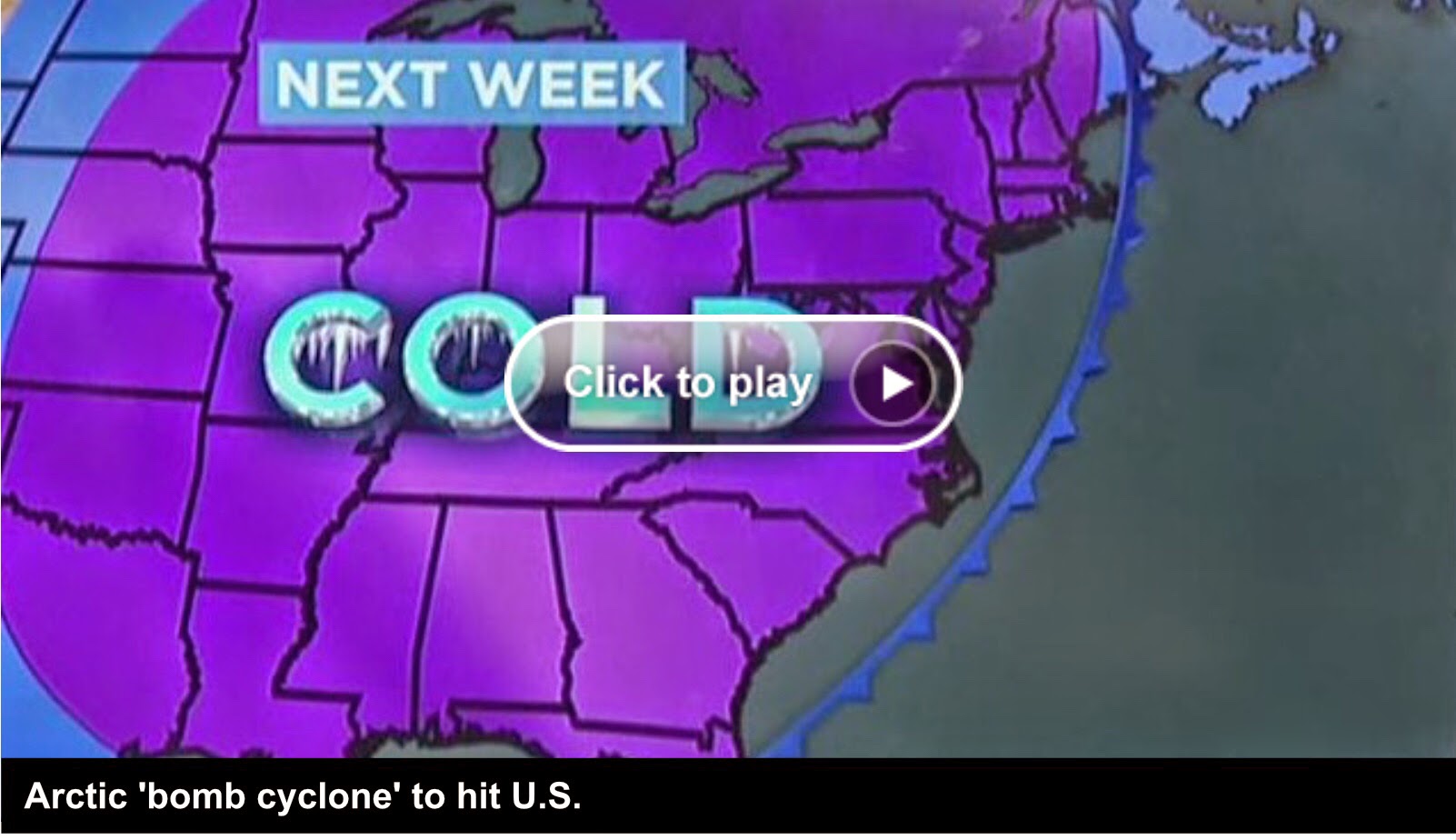
Arctic snap will ice Northern states, whipped down by 'bomb cyclone'

(CNN)The ice man cometh. And does so early this year, after a former Pacific typhoon flew up toward the Arctic and rammed the jet stream.

The stream has whipped south, dragging down frigid air from Canada over the northern Plains and Mountain States and the Upper Midwest, according to the National Weather Service.

It is already plunging temperatures below freezing there and will hammer them into the teens and single digits in many places by midweek, even lower in others.

Great Falls, Montana, will shiver at 9 below zero on Tuesday night.

It’s the coldest weather of the season, the weather service said.

Minneapolis could soon get a foot of snow, the service said, with the Minnesota city experiencing below-freezing temperatures that could last for eight days.

Let it snow

The snap is forecast to lay down the first broad layer of wintry snow, flurries, sleet or ice — long before winter starts — from Montana down to Nebraska and over to Wisconsin.

It will accumulate in inches in the northern Rockies, northern Plains and Great Lakes.

People farther south will also shiver. "Much of the nation east of the Rockies is expected to see a major pattern change by the beginning of the work week," the weather service said.

The western Dakotas are also forecast to get significant snow.

Lows will drop to freezing in Kansas City late Monday, then into the 20s a night later. The snap will stop short, leaving much of the Deep South and Southwest in a fall-like warm zone.

Rain is expected to hit Chicago and Milwaukee on Monday and Tuesday, with a few snowflakes mixed in, according to the service on Sunday afternoon.

Courtesy of Nuri

Residents in the northern United States can thank a whopping tropical cyclone in the Pacific Ocean for the wintry blast.

The remnants of super Typhoon Nuri rolled up north over Alaska’s Aleutian Islands on Friday, kicking off the ripple of Arctic air in the other direction.

Nuri is now the strongest known Northern Pacific cyclone on record, according to the National Weather Service Ocean Prediction Center.

Its remnants plowed into cold air adding violent energy as it went north, similar to what Superstorm Sandy did in the Atlantic two years ago. That earned it the weather moniker "bomb cyclone. More


Sunday, August 17, 2014

Wednesday's rainfall a 'once in a 200-year' weather event, climatologists say

Several weather records were broken Wednesday after 13.27 inches of rain fell at Islip Town's Long Island MacArthur Airport in what the Northeast Regional Climate Center calls a 24-hour 200-year storm event.

That means that "rainfall of this magnitude is only expected to occur once in a 200-year period," according to the center's website.

At play was a complex weather system that the National Weather Service had been monitoring for days, warning of the threat of flash flooding, in which an upper level disturbance, a low pressure area at the surface and very moist environment all combined over the area, said Tim Morrin, weather service meteorologist in Upton.

The "bull's-eye" of the heaviest rainfall that deluged an area of western Suffolk was right near MacArthur Airport, he said.

"A very small micro-scale event took place" in that area, one that is yet to be explained, he said, but that will likely be researched extensively, with follow-up papers written. Such a phenomenon is "impossible to forecast," he said, as "there's not enough skill in the computer models to pinpoint that kind of extreme" on such a small scale.

As for hourly rainfall, 5.34 inches fell from 5 to 6 a.m. Wednesday at the airport in Ronkonkoma, followed by another 4.37 inches from 6 to 7 a.m., according to the Climate Center. They may have come back-to-back, but each is considered a 500-year event, said Jessica Spaccio, a climatologist with the center, which is at Cornell University.

Records were also broken, and, "when we break a state record, that's pretty exciting," Spaccio said

According to a preliminary report from the weather service, the previous New York State record for precipitation in a 24-hour period was broken. That was set Aug. 27 to 28, 2011, in Tannersville when 11.6 inches fell during what the service referred to as Hurricane/Tropical Storm Irene.

With half the month still to go, Wednesday's rainfall also resulted in a record for the month of August, previously 13.78 inches set in 1990, the weather service said. The airport's August rainfall now stands at 13.88 inches, said the weather service, which has maintained official records for the airport for the past 30 years.

While Long Island has been considered "abnormally dry" this year by the U.S. Drought Monitor, the 13.27 inches at the airport in just about one day exceeded normal rainfall for June, July and August combined -- 11.68 inches -- based on precipitation records from 1981 to 2010, according to the Climate Center.

Wednesday's rainfall also broke the airport's all-time daily rainfall record, which was 6.74 inches set Aug. 24, 1990, Spaccio said.

And as for the record rainfall for Aug. 13 -- beating that was a piece of cake, with the previous record for that day 0.91 inches, set in 2013, the weather service said.

As for hourly rainfall amounts -- top honors now go to Wednesday from 5 to 6 a.m. when 5.34 inches fell at the airport, followed by 4.37 inches the very next hour, Spaccio said. The highest previous amount was 2.64 inches, which fell in one hour on July 18, 2007. That's based on data maintained since July 1996, she said. More


Tuesday, June 17, 2014

Two tornados approach Pilger, Neb., Monday June 16, 2014.

Two tornados approach Pilger, Neb., Monday June 16, 2014. The National Weather Service said at least two twisters touched down within roughly a mile of each other Monday in northeast Nebraska. (AP Photo/Eric Anderson)(Credit: AP)

A particularly dangerous situation across the Plains and Midwest has resulted in the "rare and horrifying" occurrence of "twin tornadoes" touching down late Monday afternoon near Pilger, Nebraska. One 5-year-old was killed in the storm, and 19 others were reported injured. According to Stanton County Sheriff Mike Unger, up to two-thirds of the the small town of 350 was heavily damaged or destroyed.

"More than half of the town is gone — absolutely gone," Stanton County Commissioner Jerry Weatherholt told the Associated Press. "The co-op is gone, the grain bins are gone, and it looks like almost every house in town has some damage. It’s a complete mess." The nearby towns of Wisner, Stanton and Pender, all about 90 miles north of Omaha, suffered damage as well.

The tornadoes, which hit about 1 to 2 miles apart, are believed to have been entirely independent. "Although rare, the phenomenon of simultaneous multiple tornadoes associated with the same severe thunderstorm is not unheard of," notes Mashable’s Andrew Freedman. "However, it is extremely rare for both tornadoes to be so intense and long-lasting."

The Associated Press has this footage of the tornadoes carving twin paths of destruction:

Friday, March 14, 2014

California Exceptional Drought Worsens

I keep hearing from some people how the storms at the end of February and the start of March had to have helped the California drought.

That all the rain that fell in the lowlands and snow in the Sierra had to have had an impact. Right after the storms in my , I was already pointing out that this was not the case. One set of storms does not end a three-year drought. In that post I stated, "The drought in California did not just develop this year, or in the last 12 months, but over the last three years. It is unrealistic to think one series of storms is going to have a huge impact on the long-term drought..."

Now, two weeks later, here is more evidence that the short period of rain and mountain snow had little impact.

Below is a comparison of the Drought Monitor maps for California from Feb. 18 (before the storms) and the one released today.

Over this span of time the area coverage of D4 drought conditions (exceptional) has actually increased substantially from 14.62 percent to 22.37 percent of the area, covering the rich farming area of the Central Coast to the San Joaquin Valley. The D3-4 area (extreme drought) did come down a little from 68.30 to 65.89, mostly in southwestern California.

I have already shown that many reservoirs in central and northern California are still at near-record low levels. The graph below shows the daily Sierra snowpack this year, compared to the previous two years and to normal.

With no substantial rain and snow expected for at least another week, and a round of near-record temperatures likely in the Central Valley and southwestern California coming for this weekend, all of these stats are not going to get any better. In fact, there is a good chance of below- to well below-normal precipitation over the next couple of weeks.


Sunday, February 16, 2014

Study: Climate change linked to extreme rain

John Fogerty once crooned "Who'll stop the rain?" Not humanity, apparently, as new research shows that human-caused climate change has significantly increased the chances of extreme rain- and snowfall around the world, along with the deadly floods that follow.

Pakistan floods 2011

This is according to two new studies published Wednesday in the British journal Nature.

While other studies have suggested that global warming may be partly responsible for an increase in heavy precipitation, what's new in this study is the formal finding that human influence has "likely made intense precipitation stronger, on average, over the second half of the 20th century," says study co-author Francis Zwiers of the University of Victoria in British Columbia.

"The observed change cannot be explained by natural fluctuations of the climate system alone," he says.

One of the studies reported that that the most significant rain and snow events were 7 percent wetter in the 1990s than they had been in the 1950s.

Scientists based their findings on rainfall data from 1951 to 1999 in Northern Hemisphere land areas, including North America, Eurasia and India.

The scientists took all the information that showed an increase in extreme rain and snow events from the 1950s through the 1990s, and ran dozens of computer models numerous times. They put in the effects of greenhouse gases -- which come from the burning of fossil fuels -- and then ran numerous models without those factors.

Only when the greenhouse gases are factored in did the models show a similar increase to what actually happened. Essentially, the computer runs show climate change is the only way to explain what's happening.

The other study dealt with the floods that swamped the U.K. in fall 2000 and determined that climate change made them over twice as likely to occur.

Why would global warming lead to more precipitation? According to study co-author Myles Allen of the University of Oxford in England, warmer air holds more water.

Senior scientist Kevin Trenberth of the National Center for Atmospheric Research in Boulder, who was not part of either study, expands on this: "The water holding capacity of the atmosphere goes up with higher temperatures (and higher sea-surface temperatures), and so there is simply more moisture lurking around waiting to be caught up in any storm."

The effects of greenhouse gases on precipitation appear to be global: "Extreme precipitation is expected to increase almost everywhere in a warmer world, even though we expect reductions in mean precipitation in some locations and increases in others," reports Zwiers.

Overall, according to Zwiers, computer models suggest that the northern high latitudes will see the largest percentage increases in mean annual precipitation, and that the tropics will see the largest percentage increases in extreme precipitation.

"Damaging weather events have always happened since well before humans had any substantial influence on climate," says Allen. "This research allows us to quantify how rising greenhouse gas levels may be loading the dice in favor of certain events, such as the U.K. floods of 2000, and against other events."

However, climate scientist Jerry North of Texas A&M University, while praising the work, said he worried that the studies were making too firm a connection based on weather data that could be poor in some locations. More


Saturday, September 28, 2013

Human Influence On Climate Clear, IPCC Report Says

It is extremely likely that human influence has been the dominant cause of the observed warming since the mid-20th century. The evidence for this has grown, thanks to more and better observations, an improved understanding of the climate system response and improved climate models.

Warming in the climate system is unequivocal and since 1950 many changes have been observed throughout the climate system that are unprecedented over decades to millennia. Each of the last three decades has been successively warmer at Earth's surface than any preceding decade since 1850, reports the Summary for Policymakers of the IPCC Working Group I assessment report, Climate Change 2013: the Physical Science Basis, approved on Friday by member governments of the IPCC in Stockholm, Sweden.

"Observations of changes in the climate system are based on multiple lines of independent evidence. Our assessment of the science finds that the atmosphere and ocean have warmed, the amount of snow and ice has diminished, the global mean sea level has risen and the concentrations of greenhouse gases have increased," said Qin Dahe, Co-Chair of IPCC Working Group I.

Thomas Stocker, the other Co-Chair of Working Group I said: "Continued emissions of greenhouse gases will cause further warming and changes in all components of the climate system. Limiting climate change will require substantial and sustained reductions of greenhouse gas emissions."

"Global surface temperature change for the end of the 21st century is projected to be likely to exceed 1.5°C relative to 1850 to 1900 in all but the lowest scenario considered, and likely to exceed 2°C for the two high scenarios," said Co-Chair Thomas Stocker. "Heat waves are very likely to occur more frequently and last longer. As Earth warms, we expect to see currently wet regions receiving more rainfall, and dry regions receiving less, although there will be exceptions," he added.

Projections of climate change are based on a new set of four scenarios of future greenhouse gas concentrations and aerosols, spanning a wide range of possible futures. The Working Group I report assessed global and regional-scale climate change for the early, mid-, and later 21st century.

"As the ocean warms, and glaciers and ice sheets reduce, global mean sea level will continue to rise, but at a faster rate than we have experienced over the past 40 years," said Co-Chair Qin Dahe. The report finds with high confidence that ocean warming dominates the increase in energy stored in the climate system, accounting for more than 90% of the energy accumulated between 1971 and 2010.

Co-Chair Thomas Stocker concluded: "As a result of our past, present and expected future emissions of CO2, we are committed to climate change, and effects will persist for many centuries even if emissions of CO2 stop."

Rajendra Pachauri, Chair of the IPCC, said: "This Working Group I Summary for Policymakers provides important insights into the scientific basis of climate change. It provides a firm foundation for considerations of the impacts of climate change on human and natural systems and ways to meet the challenge of climate change." These are among the aspects assessed in the contributions of Working Group II and Working Group III to be released in March and April 2014. The IPCC Fifth Assessment Report cycle concludes with the publication of its Synthesis Report in October 2014.

"I would like to thank the Co-Chairs of Working Group I and the hundreds of scientists and experts who served as authors and review editors for producing a comprehensive and scientifically robust summary. I also express my thanks to the more than one thousand expert reviewers worldwide for contributing their expertise in preparation of this assessment," said IPCC Chair Pachauri.

The Summary for Policymakers of the Working Group I contribution to the IPCC Fifth Assessment Report (WGI AR5) is available at www.climatechange2013.org or www.ipcc.ch.


Friday, September 20, 2013

Photos Show Why the Colorado Floods Are Being Called ‘Biblical’

Four people in Colorado this week already lost their lives in the record-breaking rains and floods that are battering parts of the state, forcing thousands to evacuate their homes.

On Friday, Governor John Hickenlooper declared a disaster emergency for 14 counties from the Wyoming border to Colorado Springs. President Obama also declared a federal state of emergency for Boulder, Larimer, and El Paso counties, allowing FEMA to deploy four rescue teams to those areas.

This afternoon, Reuters reports that a fifth victim, a 60-year-old woman who was swept away by flood waters, is now missing and presumed dead.

With no signs of a slow-down, even the comparatively shorter rains expected this weekend are expected to cause further flash-flooding as areas of Colorado's landscape are already well oversaturated.

Unlike other recent flooding disasters in countries like Taiwan and China, Colorado's defies expectation. September tends to be a drier month for the state, reports National Geographic.

Sandra Postel, National Geographic's Freshwater Fellow, tells the magazine that the flooding may be linked to recent droughts, which have hardened the soil of the Colorado River Basin, preventing it from absorbing much of the rainfall. Forest fires may also shoulder some of the blame; a portion of the vegetation normally responsible for trapping rainwater burned to the ground in recent years.

The most pressing question remains: How much of a hand has global warming played in these events? Climate Central's Andrew Freedmanwrites:

"It will take climate scientists many months to complete studies into whether manmade global warming made the Boulder flood more likely to occur, but the amount by which this event has exceeded past events suggests that manmade warming may have played some role by making the event worse than it would have otherwise been." More


Wednesday, September 18, 2013

Colorado and industry working to assess damage in flooded oil fields

Colorado's richest oil field — the Denver-Julesburg Basin — is buried in floodwaters, raising operational and environmental concerns, as state and industry officials work to get a handle on the problem.

Champion Greens neighborhood in Longmont, CO

Thousands of wells and operating sites have been affected — some remain in rushing waters, officials said.

"The scale is unprecedented," said Mike King, executive director of the Colorado Department of Natural Resources. "We will have to deal with environmental contamination from whatever source."

Any pollution from oil fields likely will be mixed with a stew of agricultural pesticides, sewage, gasoline from service stations and other contaminants, King said.

"As far as we know, all wells affected by flooding have been shut," said Tisha Schuller, president of the Colorado Oil and Gas Association, a trade group.

The basin, one of the most promising onshore oil plays, has been the target of an estimated $4 billion of oil industry investment, with about 48 rigs operating when the flood hit.

Companies are using boats and helicopters to check sites not accessible by road, Schuller said.

"As water levels recede, operators are assessing any damage and addressing it," she said.

The major public health risks will come from contaminated water and sediments, said Miriam Rotkin-Ellman, a Natural Resources Defense Council staff scientist.

"The aim is to find where there may be significant pollutants and where they are heading," said Rotkin-Ellman, who studied industrial contamination in New Orleans after Hurricane Katrina.

The

Colorado Oil and Gas Conservation Commission is setting up a clearinghouse to log the status of every well and operation, said Matt Lepore, the commission's executive director.

The commission also is using its mapping technology to identify well sites along the South Platte River for inspection.

"Mapping is a really good first step — it locates where the problem could be," said NRDC's Rotkin-Ellman.

The commission is forming teams — including inspectors, engineers and environmental specialists — to focus on locations north and south of the South Platte.

Still, the specter of pollution has raised concerns among environmentalist and community groups.

"With the Texas Gulf Coast, they know in advance a hurricane is coming," said Irene Fortune, a retired chemist who worked for British Petroleum and is now running for the Loveland City Council.

"To have something this inland, this level of flooding in an area with high oil and gas development, it's new territory," Fortune said.

Gary Wockner, Colorado Program Director for Clean Water Action, said, "Every flooded well needs to get inspected.

"The COGCC needs to pass new regulations for drilling in floodplains to better protect people and the environment."

There are more than 20,000 wells in th e DJ-Basin and surrounding areas and 3,200 permits for open pits in Weld County, according to state data.

A review of the pit permits, however, found a significant number are old permits that may not be operating — most were to hold produced water that contains salts and metals from wells.

Major operators in the basin said they were able to shut all the wells hit by the flood.

Encana Oil & Gas (USA) has shut about one-third of its 1,241 wells, the company said.

"We have plans in place to inspect all of our facilities," Doug Hock, an Encana spokesman, said in an e-mail. "We're using (geographic information systems) to help prioritize lower-lying facilities that may likely have greater impacts."

Anadarko Petroleum Corp., the second-largest operator in the basin, shut wells and stopped drilling activity.

"The majority of our drilling, completions and workover activities in the affected areas of the field have been shut down," the company said on its website.

"Restarting the activities is expected to be significantly delayed due to road and location conditions," the company said.

The well sites are designed to withstand harsh weather, said William Fleckenstein, a professor of petroleum engineering at the Colorado School of Mines.

"The actual wells are meant to hold pressure on the inside. They're designed to be fluid-tight," Fleckenstein said.

Concern arises when tanks are knocked over or damaged, Fleckenstein said.

The "worst-case scenario," however, would be damage to a high-pressure gas line, which would leak hydrocarbons in the air and be "very explosive," Fleckenstein said.

The impact of the flood waters has been uneven in the basin, said the oil and gas association's Schuller. Some areas are untouched, and some facilities are still surrounded by flowing water, Schuller said.

"It may take some operations a week to get back up," Schuller said. "It may take a year for others."

Pictures of flooded well and drilling sites and damaged or floating tanks have been appearing on several social-media sites.

"We've seen the pictures but don't know the locations," Schuller said. "If people provide the locations, we will check them." More

Mark Jaffe: 303-954-1912, mjaffe@denverpost.com or twitter.com/bymarkjaffe