Showing posts with label flooding. Show all posts

Sunday, November 9, 2014

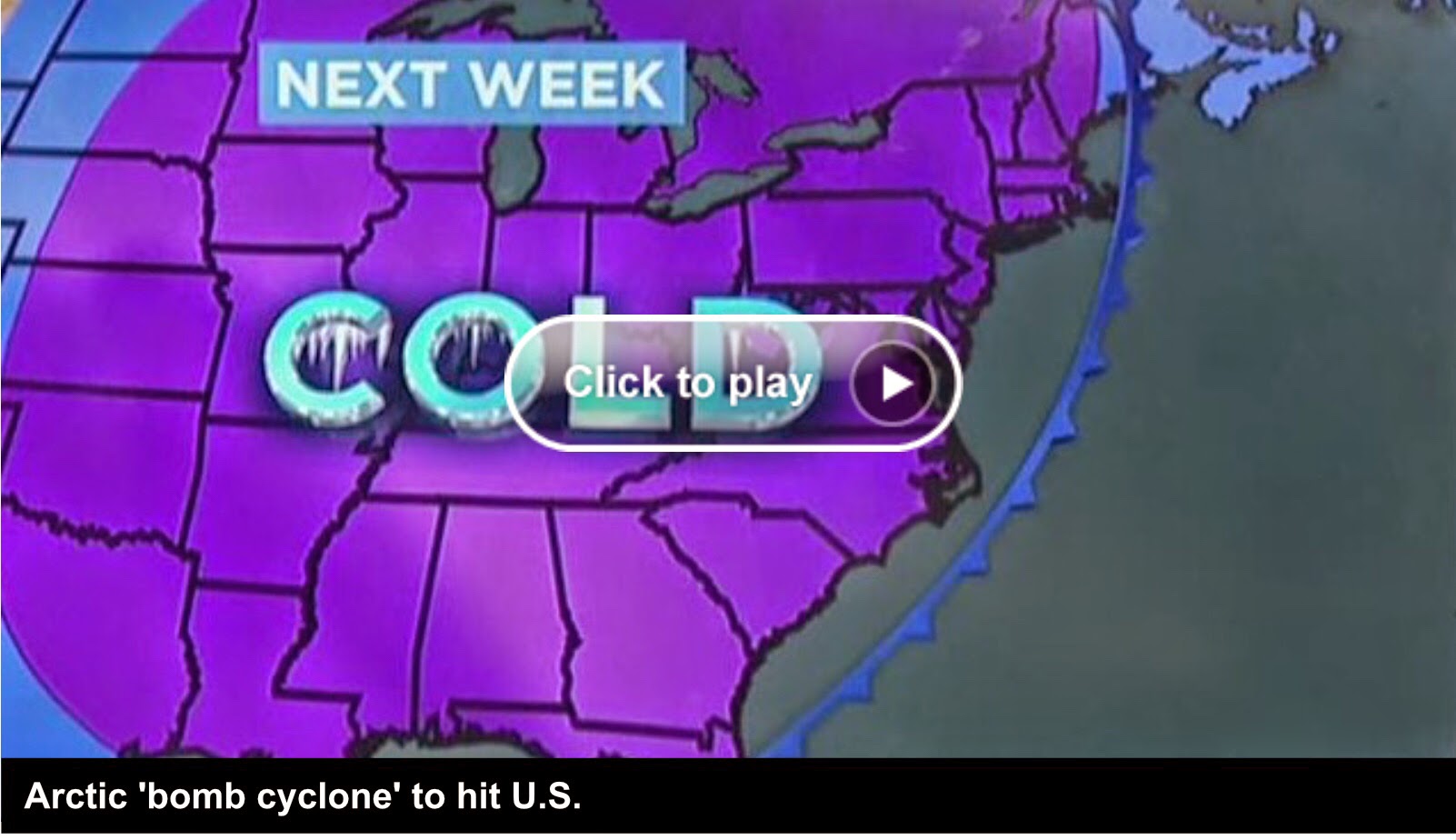
Arctic snap will ice Northern states, whipped down by 'bomb cyclone'

(CNN)The ice man cometh. And does so early this year, after a former Pacific typhoon flew up toward the Arctic and rammed the jet stream.

The stream has whipped south, dragging down frigid air from Canada over the northern Plains and Mountain States and the Upper Midwest, according to the National Weather Service.

It is already plunging temperatures below freezing there and will hammer them into the teens and single digits in many places by midweek, even lower in others.

Great Falls, Montana, will shiver at 9 below zero on Tuesday night.

It’s the coldest weather of the season, the weather service said.

Minneapolis could soon get a foot of snow, the service said, with the Minnesota city experiencing below-freezing temperatures that could last for eight days.

Let it snow

The snap is forecast to lay down the first broad layer of wintry snow, flurries, sleet or ice — long before winter starts — from Montana down to Nebraska and over to Wisconsin.

It will accumulate in inches in the northern Rockies, northern Plains and Great Lakes.

People farther south will also shiver. "Much of the nation east of the Rockies is expected to see a major pattern change by the beginning of the work week," the weather service said.

The western Dakotas are also forecast to get significant snow.

Lows will drop to freezing in Kansas City late Monday, then into the 20s a night later. The snap will stop short, leaving much of the Deep South and Southwest in a fall-like warm zone.

Rain is expected to hit Chicago and Milwaukee on Monday and Tuesday, with a few snowflakes mixed in, according to the service on Sunday afternoon.

Courtesy of Nuri

Residents in the northern United States can thank a whopping tropical cyclone in the Pacific Ocean for the wintry blast.

The remnants of super Typhoon Nuri rolled up north over Alaska’s Aleutian Islands on Friday, kicking off the ripple of Arctic air in the other direction.

Nuri is now the strongest known Northern Pacific cyclone on record, according to the National Weather Service Ocean Prediction Center.

Its remnants plowed into cold air adding violent energy as it went north, similar to what Superstorm Sandy did in the Atlantic two years ago. That earned it the weather moniker "bomb cyclone. More


Monday, September 29, 2014

Explaining Extreme Events of 2013

A report released today investigates the causes of a wide variety of extreme weather and climate events from around the world in 2013. Published by the Bulletin of the American Meteorological Society, "Explaining Extreme Events of 2013 from a Climate Perspective (link is external)" addresses the causes of 16 individual extreme events that occurred on four continents in 2013. NOAA scientists served as three of the four lead editors on the report.

Of the five heat waves studied in the report, human-caused climate change was found to have clearly increased the severity and likelihood of those events. On the other hand, for other events examined like droughts, heavy rain events, and storms, fingerprinting the influence of human activity was more challenging. Human influence on these kinds of events—primarily through the burning of fossil fuels—was sometimes evident, but often less clear, suggesting natural factors played a far more dominant role.

"This annual report contributes to a growing field of science which helps communities, businesses and nations alike understand the impacts of natural and human-caused climate change," said Thomas R. Karl, L.H.D., director of NOAA’s National Climatic Data Center. "The science remains challenging, but the environmental intelligence it yields to decision makers is invaluable and the demand is ever-growing."

Confidence in the role of climate change about any one event is increased when multiple groups using independent methods come to similar conclusions. For example, in this report, five independent research teams looked at specific factors related to the record heat in Australia in 2013. Each consistently found that human-caused climate change increased the likelihood and severity of that event. However, for the California drought, which was investigated by three teams from the United States, human factors were found not to have influenced the lack of rainfall. One team found evidence that atmospheric pressure patterns increased due to human causes, but the influence on the California drought remains uncertain.

When human influence for an event cannot be conclusively identified with the scientific tools available today, this means that if there is a human contribution, it cannot be distinguished from natural climate variability.

"There is great scientific value in having multiple studies analyze the same extreme event to determine the underlying factors that may have influenced it," said Stephanie C. Herring, PhD, lead editor for the report at NOAA’s National Climatic Data Center. "Results from this report not only add to our body of knowledge about what drives extreme events, but what the odds are of these events happening again—and to what severity."

The report was edited by Herring, along with Martin P. Hoerling, NOAA’s Earth System Research Laboratory; Thomas Peterson, NOAA’s National Climatic Data Center, and Peter A. Stott, UK Met Office Hadley Centre and written by 92 scientists from 14 countries. View the full report online (link is external).

Also, view the slides for the media briefing on the "Explaining Extreme Events of 2013 from a Climate Perspective" report. More


Sunday, August 24, 2014

450,000 people affected by flooding in E. China

450,000 people affected by flooding in E. China

Published on Aug 22, 2014 • Heavy rainfall hitting east China's Zhejiang Province for over a week has triggered floods and affected 450 thousand people. Hundreds of homes are destroyed and nearly 40 thousand people have been evacuated.

Monday, May 19, 2014

Balkan floods: 'Quarter of Bosnia' without clean water

About a quarter of Bosnia-Hercegovina's four million people are without clean water after the worst flooding since modern records began, the foreign minister has said.

Zlatko Lagumdzija said the destruction was "terrifying" and compared it to Bosnia's 1992-95 war.

At least 35 people have died in Serbia and Bosnia in flooding caused by unprecedented torrential rain. More victims are expected to be found as the waters recede.

"The consequences of the floods are terrifying," Mr Lagumdzija told a news conference. "The physical destruction is not less than the destruction caused by the war."

He said more than 100,000 houses and other buildings were no longer usable and the road infrastructure was badly damaged. He also said there had been about 2,000 landslides, some of which were on minefields left over from the war. Nearly 120,000 unexploded landmines remain in more than 9,400 carefully marked minefields. But the weather has dislodged warning signs and in many cases loosened the mines themselves. "During the war many people lost everything. Today, again they have nothing," Mr Lagumdzija said.

Bosnian civil defence officials said as many as 500,000 people had been evacuated or left their homes. Rescue helicopters from the European Union, the US and Russia have helped evacuate people from affected areas.

North-eastern Bosnia is reported to be especially badly affected, with houses, roads and rail lines submerged. In the town of Orasje, frantic efforts were being made to stop the swollen River Sava further surging through broken barriers. The emergency commander in the town, Fahrudin Solak, said the decaying corpses of drowned farm animals now represented a major health risk.

Although the waters were receding in some areas, a new flood wave from the River Sava on Monday threatened Serbia's largest power plant, the Nikola Tesla complex, 30km (18 miles) south-west of the capital, Belgrade.

The coal-fired plant in the town of Obrenovac produces about half of Serbia's electricity, and soldiers and energy workers worked through the night to build barriers of sandbags to keep the water back. Serbian emergency official Predrag Maric said the situation in Obrenovac was critical and on Monday the entire town was ordered to be evacuated.

Evacuation orders were also made for 11 villages along the River Sava ahead of the flood wave. Officials say that three months' worth of rain has fallen on the Balkans in recent days, producing the worst floods since rainfall measurements began 120 years ago. More


Saturday, March 1, 2014

Mind-blowing view of vigorous California storm

Drought-stricken Southern California is getting doused by a powerhouse storm that looks like a hurricane, except it’s not.

On water vapor imagery, the storm shows off an unmistakable counterclockwise swirl and a well-defined center with an eye-like appearance. But, in reality, this is just a mid-latitude storm – albeit an intense [and potentially dangerous] one. Its lowest central pressure is 975 mb, the equivalent of a category 1 or 2 hurricane. It kind of resembles a cinnamon roll, or a snail.

Here’s another look at the storm via infrared satellite imagery:

And here’s a summary of the impacts expected from the storm, from the National Weather Service in Los Angeles:


Sunday, February 16, 2014

Study: Climate change linked to extreme rain

John Fogerty once crooned "Who'll stop the rain?" Not humanity, apparently, as new research shows that human-caused climate change has significantly increased the chances of extreme rain- and snowfall around the world, along with the deadly floods that follow.

Pakistan floods 2011

This is according to two new studies published Wednesday in the British journal Nature.

While other studies have suggested that global warming may be partly responsible for an increase in heavy precipitation, what's new in this study is the formal finding that human influence has "likely made intense precipitation stronger, on average, over the second half of the 20th century," says study co-author Francis Zwiers of the University of Victoria in British Columbia.

"The observed change cannot be explained by natural fluctuations of the climate system alone," he says.

One of the studies reported that that the most significant rain and snow events were 7 percent wetter in the 1990s than they had been in the 1950s.

Scientists based their findings on rainfall data from 1951 to 1999 in Northern Hemisphere land areas, including North America, Eurasia and India.

The scientists took all the information that showed an increase in extreme rain and snow events from the 1950s through the 1990s, and ran dozens of computer models numerous times. They put in the effects of greenhouse gases -- which come from the burning of fossil fuels -- and then ran numerous models without those factors.

Only when the greenhouse gases are factored in did the models show a similar increase to what actually happened. Essentially, the computer runs show climate change is the only way to explain what's happening.

The other study dealt with the floods that swamped the U.K. in fall 2000 and determined that climate change made them over twice as likely to occur.

Why would global warming lead to more precipitation? According to study co-author Myles Allen of the University of Oxford in England, warmer air holds more water.

Senior scientist Kevin Trenberth of the National Center for Atmospheric Research in Boulder, who was not part of either study, expands on this: "The water holding capacity of the atmosphere goes up with higher temperatures (and higher sea-surface temperatures), and so there is simply more moisture lurking around waiting to be caught up in any storm."

The effects of greenhouse gases on precipitation appear to be global: "Extreme precipitation is expected to increase almost everywhere in a warmer world, even though we expect reductions in mean precipitation in some locations and increases in others," reports Zwiers.

Overall, according to Zwiers, computer models suggest that the northern high latitudes will see the largest percentage increases in mean annual precipitation, and that the tropics will see the largest percentage increases in extreme precipitation.

"Damaging weather events have always happened since well before humans had any substantial influence on climate," says Allen. "This research allows us to quantify how rising greenhouse gas levels may be loading the dice in favor of certain events, such as the U.K. floods of 2000, and against other events."

However, climate scientist Jerry North of Texas A&M University, while praising the work, said he worried that the studies were making too firm a connection based on weather data that could be poor in some locations. More


Thursday, February 13, 2014

UK storms and floods show climate change is upon us - Lord Stern

The record rainfall and storm surges that have brought flooding across the UK are a clear sign that we are already experiencing the impacts of climate change.

Many commentators have suggested that we are suffering from unprecedented extreme weather. There are powerful grounds for arguing that this is part of a trend.

Four of the five wettest years recorded in the UK have occurred from the year 2000 onwards. Over that same period, we have also had the seven warmest years.

That is not a coincidence. There is an increasing body of evidence that extreme daily rainfall rates are becoming more intense, in line with what is expected from fundamental physics, as the Met Office pointed out earlier this week.

A warmer atmosphere holds more water. Add to this the increase in sea level, particularly along the English Channel, which is making storm surges bigger, and it is clear why the risk of flooding in the UK is rising.

But it is not just here that the impacts of climate change have been felt through extreme weather events over the past few months. Australia has just had its hottest year on record, during which it suffered record-breaking heatwaves and severe bushfires in many parts of the country. And there has been more extreme heat over the past few weeks.

Argentina had one of its worst heatwaves in late December, while parts of Brazil were struck by floods and landslides following record rainfall.

And very warm surface waters in the north-west Pacific during November fuelled Typhoon Haiyan, the strongest tropical cyclone to make landfall anywhere in the world, which killed more than 5,700 people in the Philippines.

This is a pattern of global change that it would be very unwise to ignore.

The Intergovernmental Panel on Climate Change last September pointed to a changing pattern of extreme weather since 1950, with more heatwaves and downpours in many parts of the world, as the Earth has warmed by about 0.7C.

The IPCC has concluded from all of the available scientific evidence that it is 95% likely that most of the rise in global average temperature since the middle of the 20th century is due to emissions of greenhouse gases, deforestation and other human activities.

The upward trend in temperature is undeniable, despite the effects of natural variability in the climate which causes the rate of warming to temporarily accelerate or slow for short periods, as we have seen over the past 15 years.

If we do not cut emissions, we face even more devastating consequences, as unchecked they could raise global average temperature to 4C or more above pre-industrial levels by the end of the century.

This would be far above the threshold warming of 2C that countries have already agreed that it would be dangerous to breach. The average temperature has not been 2C above pre-industrial levels for about 115,000 years, when the ice-caps were smaller and global sea level was at least five metres higher than today.

The shift to such a world could cause mass migrations of hundreds of millions of people away from the worst-affected areas. That would lead to conflict and war, not peace and prosperity.

In fact, the risks are even bigger than I realised when I was working on the review of the economics of climate change for the UK government in 2006. Since then, annual greenhouse gas emissions have increased steeply and some of the impacts, such as the decline of Arctic sea ice, have started to happen much more quickly.

We also under-estimated the potential importance of strong feedbacks, such as the thawing of the permafrost to release methane, a powerful greenhouse gas, as well as tipping points beyond which some changes in the climate may become effectively irreversible.

What we have experienced so far is surely small relative to what could happen in the future. We should remember that the last time global temperature was 5C different from today, the Earth was gripped by an ice age.

So the risks are immense and can only be sensibly managed by reducing greenhouse gas emissions, which will require a new low-carbon industrial revolution.

History teaches us how quickly industrial transformations can occur through waves of technological development, such as the introduction of electricity, based on innovation and discovery.

We are already seeing low-carbon technologies being deployed across the world, but further progress will require investment and facing up to the real prices of energy, including the very damaging emissions from fossil fuels.

Unfortunately, the current pace of progress is not nearly rapid enough, with many rich industrialised countries being slow to make the transition to cleaner and more efficient forms of economic growth.

The lack of vision and political will from the leaders of many developed countries is not just harming their long-term competitiveness, but is also endangering efforts to create international co-operation and reach a new agreement that should be signed in Paris in December 2015.

Delay is dangerous. Inaction could be justified only if we could have great confidence that the risks posed by climate change are small. But that is not what 200 years of climate science is telling us. The risks are huge.

Fortunately poorer countries, such as China, are showing leadership and beginning to demonstrate to the world how to invest in low-carbon growth.

The UK must continue to set an example to other countries. The 2008 Climate Change Act, which commits the UK to cut its emissions by at least 80% by 2050, is regarded around the world as a model for how politicians can create the kind of clear policy signal to the private sector which could generate billions of pounds of investment. Weakening the Act would be a great mistake and would undermine a strong commitment made by all of the main political parties.

Squabbling and inconsistent messages from ministers, as well as uncertainty about the policies of possible future governments, are already eroding the confidence of businesses. Government-induced policy risk has become a serious deterrent to private investment.

Instead, the UK should work with the rest of the European Union to create a unified and much better functioning energy market and power grid structure. This would also increase energy security, lower costs and reduce emissions. What better way is there to bring Europe together?

The government will also have to ensure the country becomes more resilient to those impacts of climate change that cannot now be avoided, including by investing greater sums in flood defences.

It should resist calls from some politicians and parts of media to fund adaptation to climate change by cutting overseas aid. It would be deeply immoral to penalise the 1.2 billion people around the world who live in extreme poverty.

In fact, the UK should be increasing aid to poor countries to help them develop economically in a climate that is becoming more hostile largely because of past emissions by rich countries.

A much more sensible way to raise money would be to implement a strong price on greenhouse gas pollution across the economy, which would also help to reduce emissions. It is essential that the government seizes this opportunity to foster the wave of low-carbon technological development and innovation that will drive economic growth and avoid the enormous risks of unmanaged climate change. More

Nicholas Stern is chair of the Grantham Research Institute on Climate Change and the Environment at the LSE and president of the British Academy.
 

Tuesday, October 22, 2013

Chinese climate expert Dr. Qin Dahe has received the Volvo Group’s Environment Prize 2013

Chinese climate expert Dr. Qin Dahe has received the Volvo Group’s Environment Prize 2013, which has a prize sum of 1.5 million kronor.

Dr. Qin Dahe

Dr. Qin is one of the key contributors to the new reports from the UN climate panel (IPPC). He also attracted wide attention last year for his report on how climate change leads to more extreme weather events.

The report was the first to scientifically show that extreme weather and climate phenomena have become more frequent over the last 50 years. The findings showed a clear connection between climate change and periods of extreme conditions, such as extended droughts and heat waves, as well as torrential storms and rains.

The Volvo Award Jury called the report “a game-changer”, and wrote in its motivation: “the report demonstrated for the first time a clear link between climate change and many extreme events, an issue of immediate relevance for human well-being in many parts of the world”.

Dr Qin is also a leading expert on cryosphere in central high Asia and its importance. The cryosphere is one of the main components of the Earth’s climate system, comprising snow, river and lake ice, sea ice, glaciers, ice shelves, and frozen ground. Especially, glaciers have important impacts on water resources and ecosystems for more than two billion people in Asia.

Dr Qin has led several scientific expeditions to the Himalayas, and also been on expeditions to the Antarctic.

“There is no doubt that the major part of the glaciers in the Himalayas is disappearing fast. But one of the research areas we will tackle is the question of whether the Greenland ice cap is stable or not. And as well, the risks for more extreme occurrences such as drought, floods and storms,” said Dr Qin in a statement from Volvo Group.

The prize will be handed out at a ceremony in Stockholm on November 26. More


Saturday, October 12, 2013

At least 5 dead as Cyclone Phailin hits India

NEW DELHI — A gigantic cyclone, one of the strongest ever to hit the Bay of Bengal, pounded India's eastern cost with heavy winds and rain Saturday, as more than half a million people fled the region.

Cyclone Phailin

The Press Trust of India, a local news agency, reported at least 5 people died from heavy rains ahead of the storm. Indian government officials later said early reports of deaths from the storm won't become clear until daybreak Sunday, the Associated Press reported. Hundreds of trees were uprooted before the eye of the storm even made landfall early evening local time and flights, trains and shipping operations were canceled and power shut down in six districts in the coastal area.

The India Meteorological Department said the cyclone made landfall near Gopalpur, India, with sustained winds of 124 mph — equivalent to a Category 3 hurricane.

Cyclone Phailin caused one of the largest evacuation operations in Indian history, with 600,000 people moved to higher ground in the coastal state of Odisha, which is expected to bear the brunt of the storm.

Electricity had been cut off in the entire state as a precaution, said Indian navy retired commodore A.K Patnaik, in Bhubaneshwar, the capital of Odisha, who was reached by phone before he shut it down to conserve power.

"It has been raining very heavily here since yesterday, the streets are flooded, and electricity was shut down this morning," he said. "The streets are empty, everyone is indoors, and people stocked up on groceries and essentials yesterday."

Satellite images showed the cyclone filling nearly the entire Bay of Bengal, an area larger than France that has seen the majority of the world's worst recorded storms, including a 1999 cyclone that killed 10,000.

"If it's not a record, it's really, really close," University of Miami hurricane researcher Brian McNoldy told The Associated Press. "You really don't get storms stronger than this anywhere in the world ever."

To compare it to killer U.S. storms, McNoldy said Phailin is nearly the size of Hurricane Katrina, which killed 1,200 people in 2005 and caused devastating flooding in New Orleans, but also has the wind power of 1992's Hurricane Andrew, which packed 265 kph (165 mph) winds at landfall in Miami.

"The storm has the potential to cause huge damage," L.S. Rathore, director-general of the Indian Meteorlogical Department told reporters.

The epicenter of the cyclone is likely to be close to the major port of Paradip in Odisha.

"We have stopped all cargo operations," Paradip Port Trust Chairman Sudhanshu Shekhara Mishra told the Press Trust of India, a local news agency. "We have set up control rooms and are ready with a contingency plan. We have cleared all vessels. People have been evacuated from low-lying areas."

The state has created 800 shelters as government workers and volunteers put together food packages for relief camps.

"I don't want people to panic," said Naveen Patnaik, chief minister of Odisha told PTI, calling for everyone to do their part in helping relief operations. More


Friday, September 20, 2013

Photos Show Why the Colorado Floods Are Being Called ‘Biblical’

Four people in Colorado this week already lost their lives in the record-breaking rains and floods that are battering parts of the state, forcing thousands to evacuate their homes.

On Friday, Governor John Hickenlooper declared a disaster emergency for 14 counties from the Wyoming border to Colorado Springs. President Obama also declared a federal state of emergency for Boulder, Larimer, and El Paso counties, allowing FEMA to deploy four rescue teams to those areas.

This afternoon, Reuters reports that a fifth victim, a 60-year-old woman who was swept away by flood waters, is now missing and presumed dead.

With no signs of a slow-down, even the comparatively shorter rains expected this weekend are expected to cause further flash-flooding as areas of Colorado's landscape are already well oversaturated.

Unlike other recent flooding disasters in countries like Taiwan and China, Colorado's defies expectation. September tends to be a drier month for the state, reports National Geographic.

Sandra Postel, National Geographic's Freshwater Fellow, tells the magazine that the flooding may be linked to recent droughts, which have hardened the soil of the Colorado River Basin, preventing it from absorbing much of the rainfall. Forest fires may also shoulder some of the blame; a portion of the vegetation normally responsible for trapping rainwater burned to the ground in recent years.

The most pressing question remains: How much of a hand has global warming played in these events? Climate Central's Andrew Freedmanwrites:

"It will take climate scientists many months to complete studies into whether manmade global warming made the Boulder flood more likely to occur, but the amount by which this event has exceeded past events suggests that manmade warming may have played some role by making the event worse than it would have otherwise been." More


After the Storms, A Different Opinion on Climate Change

Extreme weather may lead people to think more seriously about climate change, according to new research. In the wake of Hurricanes Irene and Sandy, New Jersey residents were more likely to show support for a politician running on a “green” platform, and expressed a greater belief that climate change is caused by human activity.

This research, published in Psychological Science, a journal of the Association for Psychological Science, suggests that traumatic weather events may have the power to shift people’s automatic attitudes — their first instincts — in favor of environmentally sustainable policies.

Though scientists are in near-unilateral agreement that human activity contributes to climate change, the relationship isn’t as clear to many politicians and citizens. This translates into lackluster support for environmental policies, especially when the short-term consequences amount to higher taxes.

“Americans tend to vote more from a self-interested perspective rather than demand that their government affect change,” says lead researcher Laurie Rudman of Rutgers University.

In 2010, Rudman and her colleagues Meghan McLean and Martin Bunzl surveyed over 250 Rutgers undergraduate students, measuring their attitudes toward two politicians, one who favored and another who opposed environmental policies that involve tax increases. The researchers asked the students whether they believed that humans are causing climate change, and they also had the students complete a test intended to reveal their automatic, instinctual preferences toward the politicians.

Though most students said they preferred the green politician, their automatic preferences suggested otherwise. The automatic-attitudes test indicated that the students tended to prefer the politician who did not want to raise taxes to fund environment-friendly policy initiatives.

After Hurricanes Irene and Sandy devastated many areas on the Eastern Seaboard in 2012, Rudman and colleagues wondered whether they would see any differences in students’ attitudes toward environmental policies.

“It seemed likely that what was needed was a change of ‘heart,’” Rudman explains. “Direct, emotional experiences are effective for that.”

In contrast with the first group, students tested in 2012 showed a clear preference for the green politician, even on the automatic attitudes test. And those students who were particularly affected by Hurricane Sandy – experiencing power outages, school disruptions, even damaged or destroyed homes – showed the strongest preference for the green politician.

“Not only was extreme weather persuasive at the automatic level, people were more likely to base their decisions on their gut-feelings in the aftermath of Sandy, compared to before the storm,” Rudman explains.

While they don’t know whether the first group of students would have shown a shift in attitudes after the storms, the researchers believe their findings provide evidence that personal experience is one factor that can influence instinctive attitudes toward environmental policy. If storms do become more prevalent and violent as the climate changes, they argue, more people may demand substantive policy changes. More

Friday, September 13, 2013

Massive Flooding Shuts Down Entire Region of Northern Colorado Read more: PHOTOS: Massive Flooding Shuts Down Entire Region of Northern Colorado

The Northern Colorado Front Range is experiencing an unprecedented flood that has stranded and displaced thousands of residents and shut down well over a dozen towns.

Every river and stream in an 80 mile swath from west of Denver to Ft Collins has overflowed its banks, taking out major highways to towns in the mountains, and flooding entire communities downstream. While flooding has been a concern for years and flood controls have been built up, the sheer scale and volume of the rains have ground Colorado to a halt while altering the landscape to an unrecognizable state and prompting a state of emergency throughout the region. From my vantage on a mountain 10 miles west of Fort Collins, the sound of water cascading through the vast valley below fills the air, and all roads further west are closed.

The true scope of the damage will not be known for some time. The record-breaking forest fires in Larimer County and Colorado Springs last year have hampered the ability of the landscape to absorb the water, which has only aggravated the damage. The large rain totals (which have been gauged up to 11 inches in Boulder and 15 inches higher up) are a result of monsoonal moisture traveling north from the Gulf of Mexico. That moisture combined with a low pressure system to the west has created an upslope weather phenomena in which the Rocky Mountains literally squeeze the rain out of the clouds.

While the rains are finally subsiding, the volume of water in the mountains streams is actually picking up, closing virtually every bridge in Larimer and Boulder counties. Many roads near valley streams are destroyed along with homes and businesses. Some towns are completely isolated,including Lyons, and Estes Park (at the base of Rocky Mountain National Park) is only accessible by Trail Ridge Road – the highest paved road in the US. Many homes through the mountains are also cut off due to the roads being made impassable, if not outright destroyed.

In the larger cities at the base of the Front Range, most major bridges have closed, including I25, and neighborhoods scattered from Fort Collins to Denver have been evacuated as the waters find their way down from the mountains. Some of the flooding concerns come from failed dams like the one at Rocky Mountain Arsenal, which prompted thousands of homes to be evacuated in Commerce City, just north of Denver. Many low-laying areas near rivers all along the Front Range have also been evacuated. Others residents have been asked to shelter in place as the scale of the flooding makes many roads impassable. More rain forecasted for this weekend will keep the state on high alert. More


Sunday, September 1, 2013

Storms wreak agricultural losses of over NT$400 million in Taiwan

Taipei, Sept. 1 (CNA) Agricultural losses wreaked by two successive tropical storms in late August rose Sunday to top NT$400 million (US$13.3 million), after days of torrential rains caused flooding and landslides in several parts of Taiwan.

Since Tropical Storm Trami struck Aug. 20, which was followed by another, named Kong-Rey, agricultural crops, products, buildings and equipment have sustained losses of NT$405 million, according to the latest tallies, as of 10:00 a.m.

Yunlin County was hardest hit by the storms, with losses there reaching NT$143 million. Nearby Chiayi County in southwestern Taiwan came next, with losses of NT$131 million, according to the Council of Agriculture.

The storms took their heaviest toll in rice, vegetables and fruits, with damaged crops reaching over NT$280 million, surpassing losses in livestock, fisheries and forestry, according to the council.

Additionally, farmers throughout Taiwan lost 435,000 chickens, 24,000 geese and 32,000 pigs, valued at NT$65.2 million, according to the council. More


Thursday, August 22, 2013

Sudan deadly floods affect 300,000 people - WHO

More than 300,000 people across Sudan have been affected by floods that have killed nearly 50 people in August, the World Health Organization has said.

It said the region around the capital Khartoum had been particularly badly hit and was experiencing the worst floods in 25 years.

One of the major risks to health was the collapse of more than 53,000 latrines, the WHO added.

A UN official in Sudan described the situation as "a huge disaster".

In a report, the WHO said that 48 people had been killed and 70 injured in the floods. It warned of increasing trends of malaria cases in the past two weeks.

Meanwhile, Sudan Interior Minister Mahmoud Hamed put the confirmed death toll at 53, according to the AFP news agency.

The WHO also said property had been damaged in 14 of Sudan's 18 states.

Mark Cutts, the head of the UN Office for the Co-ordination of Humanitarian Affairs in Sudan, told AFP last week the world body was ready to help those affected by the disaster.

He added that this was despite the fact that UN humanitarian operations "have been severely underfunded" this year. More


Sunday, August 18, 2013

Yemen Floods Sweep Away Wedding Party

SANAA, Aug 17 (Reuters) - At least 27 people died and more than 41 were missing after a wedding party was swept away while driving across a valley flooded by monsoon rains in southern Yemen, local officials said on Saturday.

Sanaa, Yemen


The victims, mostly women and children, were in three vehicles accompanying the bride to her new home across Wadi Nakhla, a valley between Taiz and Ibb provinces, the officials from Shara'ab district said. The bride survived the accident.

Rescue teams were searching for those missing, the officials said. State media said that eight people had been rescued.

Yemen, situated at the southern tip of the Arabian Peninsula, is prone to flooding during the monsoon season, during which people are often killed.

Flash floods have killed at least 10 other people in Yemen in the past two days and have swept away crops.

One of the poorest countries in the world, Yemen is grappling with an al Qaeda insurgency as it tries to reform its political institutions before elections next year. (Reporting by Mohammed Ghobari; Writing by Sami Aboudi; Editing by Louise Ireland) More


Sunday, August 4, 2013

Pakistan issues fresh flood warnings

Pakistani disaster relief officials have issued fresh flood warnings after the death toll from heavy monsoon rains rose to 45 and waters paralysed parts of the largest city, Karachi.

Pakistan's National Disaster Management Authority warned on Sunday that more thunderstorms and heavy rains were expected on Monday and some rivers may flood.

Flash floods caused by monsoon downpours inundated some main roads in the sprawling port city and swept away homes in the northwestern province of Khyber Pakhtunkhwa.

Officials in Karachi said at least 19 people died in the city as 20 others died in the northwest and six in the southwestern province of Baluchistan in the floods over the weekend

Doctor Semi Jamali at the Jinnah Hospital in Karachi told AFP news agency that most of the deaths occurred due to electrocution or collapsing roofs and walls.

Army engineers helped relief efforts in Karachi on Sunday where roads and streets were flooded and the city was practically paralysed, an AFP reporter said.

Pakistan has suffered devastating monsoon floods for the last three years, including the worst in its history in 2010 when catastrophic inundations killed almost 1,800 people and affected 21 million.

Scores killed in Afghanistan

Meanwhile, flash floods triggered by days of torrential rain have killed more than 50 people inneighbouring Afghanistan, destroying dozens of houses, officials said.

An estimated 30 people remained missing on Sunday.

Provincial spokesmen in Nangarhar, Kabul, Khost, Laghman and Nuristan said all the floods struck early Saturday.

Flash floods are common in those provinces and all are fed by rivers that eventually intersect in Nangarhar.

In Kabul's Surobi district, police chief Shaghasi Ahmadi said 34 people were killed in a remote and mountainous area. He said 22 of the bodies from Surobi were later found downstream in Laghman. More